
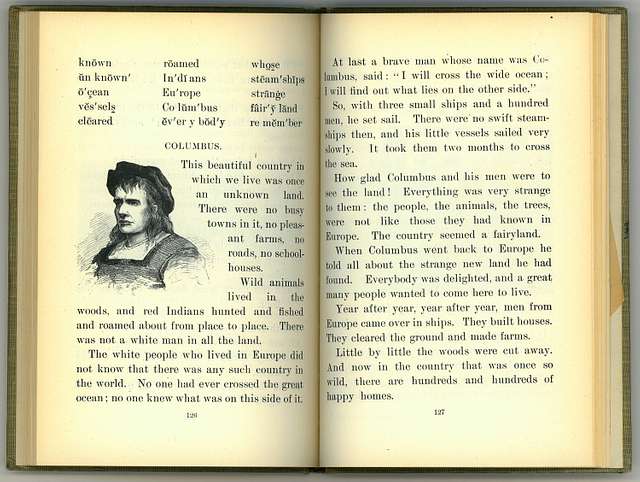
I was online the other day when I stumbled upon a little maxim from “The New England Primer,” the first textbook used by thousands of children in the early days of the American colonies. The lines ran as follows:
Have communion with few,
Be intimate with one,
Deal justly with all,
Speak evil of none.
That’s some great wisdom for life, and considering that its concise and versified nature was instilled in young children whose minds are sponges at that stage, it’s likely they remembered the advice long into adulthood.
I began wondering what other life wisdom was imparted to America’s children through their textbooks in the early years of our nation, so I dug up the first three volumes of McGuffey readers, some of the most well-known reading textbooks used in America’s one-room schools. Looking solely at the few “script” sections scattered throughout the readers – which were likely portions of text the students were supposed to copy out in order to practice their handwriting – I found the following pieces.
When the stars at set of sun
Watch you from on high,
When the morning has begun,
Think the Lord is nigh.All you do and all you say,
He can see and hear:
When you work and when you play,
Think the Lord is near.All your joys and griefs He knows,
Counts each falling tear,
When to Him you tell your woes,
Know the Lord will hear.
What kind of lessons does this simple verse drill into the hearts and minds of the children who read it? First, it establishes the fact that God is a real being, showing personal care toward those He has created. It demonstrates that He is ever present, rather than aloof, seeing all that His creatures do and say and think and experience. And finally, it recognizes the value of human life and the special role each of us plays on earth.
The Second Reader offers another profound, but fundamental principle of life:
Hark! My mother’s voice I hear.
Sweet that voice is to my ear;
Ever soft, it seems to tell,
Dearest child, I love thee well.Love me, mother? Yes, I know
None can love so well as thou.
Was it not upon thy breast
I was taught to sleep and rest?Didst thou not, in hours of pain,
Lull this head to ease again?
With the music of thy voice,
Bid my little heart rejoice?Ever gentle, meek, and mild,
Thou didst nurse thy fretful child
Teach these little feet the road
Leading on to heaven and God.What return then can I make?
This fond heart, dear mother, take;
Thine it is, in word and thought,
Thine by constant kindness bought.
This verse praises motherhood as a worthy calling, showing how a woman’s care, sacrifice, and gentleness can make a huge impact on the next generation. Such a message likely inspired millions of little girls to become worthy mothers and millions of little boys to find and marry a woman who would be a good mother to their future children.
It further teaches children to honor their parents, living a life that would reflect the kindness and goodness imparted to them by those who brought them into the world.
But even more, the line that encourages mothers to teach their children wisely and well subtly hints that parents are responsible for the training and instruction of their children, not the government, as is commonly thought today.
Moving on to the Third Reader we find the following:
Lend a hand to one another
In the daily toil of life:
When we meet a weaker brother,
Set us help him in the strife.
There is none so rich but may,
In his turn, be forced to borrow;
And the poor man’s lot to-day
May become our own to-morrow.
This verse advises readers to be good neighbors, to avoid selfishness, and to show kindness and compassion to those in need. It also encourages readers to avoid pride, recognizing that life could throw a curveball at any moment that could reverse good fortune.
To summarize, each of these three verses encapsulate the greatest commandment and the Golden Rule: “[L]ove the LORD thy God with all thy heart, with all thy soul, and with all thy mind. … And the second is like unto it, Thou shalt love thy neighbour as thyself.”
Character in Curriculum Today
For those of us with postmodern sensibilities, it seems remarkable that America’s public schools of yore would so blatantly advance principles of faith and character. Consider, instead, what today’s textbooks and classrooms teach.
Instead of teaching students to love God and draw near to Him, today’s schools tell students to love Mother Earth, and that the life of the planet and its animal creatures deserve more reverence than humanity.
Honoring parents may get lip service in schools and textbooks, but then schools turn around and act like they are the experts who know far better than parents what children need. How does such an attitude promote honor toward those who birthed them, cared for them, and love them fully?
And finally, what about loving your neighbor and lending a hand to help the less fortunate? Our schools and textbooks speak plenty about the poor and oppressed, but such references are often viewed through the lens of class struggle and the need for equality – or reparations for those who were wronged – creating an envy which squelches the outgrowth of brotherly love and neighborly help which was once advanced in America’s public schools.
“It should be your care, therefore, and mine,” John Adams once wrote, “to elevate the minds of our children and exalt their courage; to accelerate and animate their industry and activity; to excite in them an habitual contempt of meanness, abhorrence of injustice and inhumanity, and an ambition to excel in every capacity, faculty, and virtue.” In other words, children should be instilled with character – the character like that taught through these little McGuffey maxims – early and often. “If we suffer their minds to grovel and creep in infancy, they will grovel all their lives,” Adams concluded.
May we all have the wisdom and discernment to determine whether the schoolbooks used by our children today are training them to grow in courage and character … or grovel and creep for the rest of their days.
—
This article was made possible by The Fred & Rheta Skelton Center for Cultural Renewal.
Image credit: Picryl






















Leave a Comment
Your email address will not be published. Required fields are marked with *