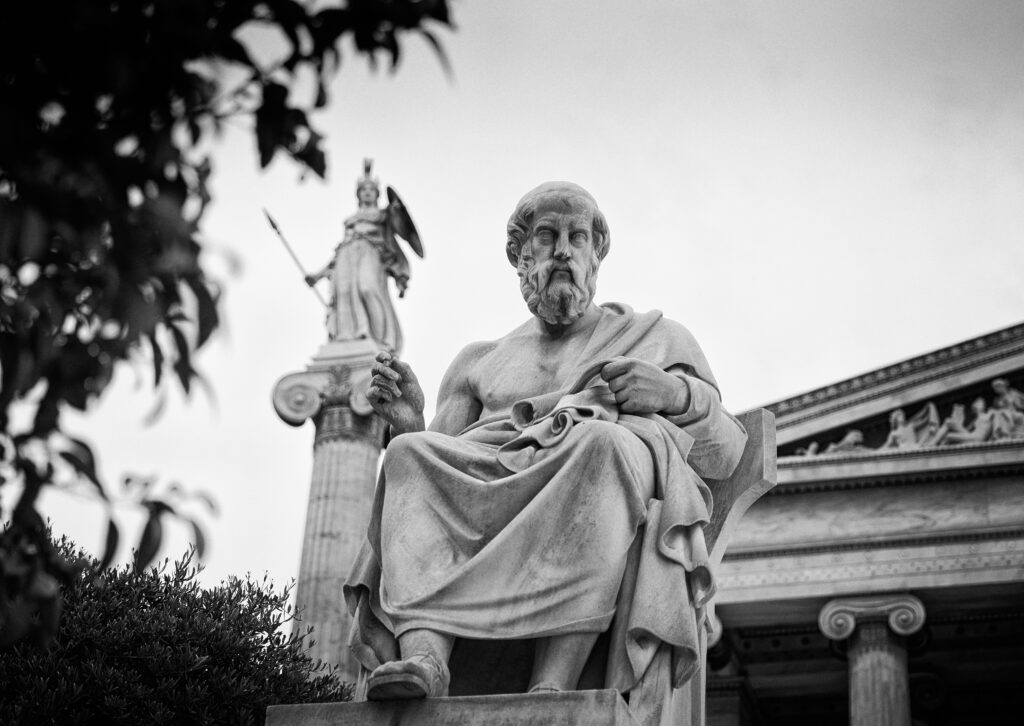
In Book VIII of Plato’s “Republic,” he outlines the process of political decay that societies tend to follow. Those lessons are both timeless and timely.
Plato’s ideal form of government is an aristocracy, a term that translates as “the rule of the best.” This is not rule by a class of wealthy elites, necessarily, but rule by the best and wisest of a country’s citizens. Plato – through the voice of his Socrates – describes them as “the best philosophers and warriors,” ruling as kings or lords and seeking to promote the common good. But Plato is also realistic, recognizing that this type of government is rare and often devolves into something lesser.
The next phase of government he calls “timocracy,” a society ruled by people who love honor and glory above all else. This is a decent but still lesser form of government than rule by aristocratic “philosopher kings” because it fixates on one particular good (honor) without accounting for the whole picture, lacking the rootedness in rationality and emphasis on holistic virtue of the true aristocrat.
Timocracy degenerates into oligarchy, a society wherein the ruling class begins loving wealth above everything else. The oligarchy ceases to be about the common good; the oligarchs become concerned instead with their own personal good, the accumulation of private wealth. “A government resting on a valuation of property, in which the rich have power and the poor man is deprived of it,” Plato describes. This disparity leads to jealousy and competition. “[O]ne, seeing another grow rich, seeks to rival him, and thus the great mass of the citizens become lovers of money. … And so they grow richer and richer, and the more they think of making a fortune the less they think of virtue….”
Plato theorizes that timocracy degenerates into democracy when the primary aim of the rulers (and the people) becomes not virtue or money, but freedom. For Plato, freedom unmoored from reason, virtue, and the common good is a destructive force. When freedom becomes the highest good, the people refuse to submit to any authority or law, including the moral law. “[S]ee how sensitive the citizens become; they chafe impatiently at the least touch of authority and at length, as you know, they cease to care even for the laws, written or unwritten; they will have no one over them.”
Thus, Plato considers a government based on freedom as an end in itself (which he calls democracy) to be one of the worst forms of government. It emerges out of oligarchy because, eventually, the people will become frustrated with the selfish rule of the oligarchs and overthrow them, depriving them of their money and wealth and placing power in the hands of the people.
At this stage – as the people attempt to throw off the shackles of the elite class – they expose themselves to an even worse danger: the rise of the populist demagogue, who will become a tyrant.
The demagogue sees the roiling dissatisfaction of the people as they push back against the inequality and injustice caused by the oligarchy and takes advantage of that momentum. He presents himself as the defender and champion of the people, the protector of “the common man.” He encourages the people’s anger at the oligarchs, and makes a “party against the rich,” promising to end the injustices of the ruling class.
“After a while he is driven out, but comes back, in spite of his enemies, a tyrant full grown,” Plato writes. “And if [the oligarchs] are unable to expel him, or to get him condemned to death by a public accusation, they conspire to assassinate him.”
Of course, at this early stage, the demagogue seems to be proving his loyalty to the common people as he battles with the oligarchs, promising to restore what the people have lost.
At first, in the early days of his power, he is full of smiles, and he salutes every one whom he meets; –he to be called a tyrant, who is making promises in public and also in private! liberating debtors, and distributing land to the people and his followers, and wanting to be so kind and good to every one!
But once he has defeated the oligarchs and harnessed the mob’s power, he begins using that power to persecute his political enemies. “By the favourite method of false accusation he brings them into court and murders them, making the life of man to disappear … some he kills and others he banishes, at the same time hinting at the abolition of debts and partition of lands….”
According to Plato, once the demagogue-turned-tyrant is in power, he will also pursue wars and raise prices.
[H]e is always stirring up some war or other, in order that the people may require a leader … Has he not also another object, which is that [the people] may be impoverished by payment of taxes, and thus compelled to devote themselves to their daily wants and therefore less likely to conspire against him? Clearly.
He’ll also take advantage of his position to line his own pockets: “If … there are sacred treasures in the city, he will confiscate and spend them….” When the treasury money runs out, he’ll take money directly from those who first put him in power.
And so, “The excess of liberty, whether in States or individuals, seems only to pass into excess of slavery.”
Plato’s analysis of the devolution of government – and particularly the transition from democracy to tyranny – seems particularly relevant to our time. I will leave it to readers to draw their own conclusions about where we are in Plato’s cycle of governmental decline, and which figures represent which forces in that story, but certainly we can see some reflections of our nation’s trajectory in Plato’s outline.
And his words should serve as a sobering warning.
—
This article was made possible by The Fred & Rheta Skelton Center for Cultural Renewal.
Image credit: Unsplash




















Leave a Comment
Your email address will not be published. Required fields are marked with *