
For Christians around the world, this is the most important week of the year, leading toward Good Friday when Jesus Christ was crucified, and culminating in Easter Sunday, when Christ achieved victory over death through His resurrection.
But what about for the non-Christian – or even for the Christian who greets the event as nothing more than an annual tradition? Is Easter just a day to gather with family and friends, hunt for eggs, and chow down on chocolate? Or is there actual historical and archeological evidence pointing to the events of Holy Week and the importance of remembering and celebrating them?
Archeologist Joel Kramer would answer the preceding question in the affirmative. According to Kramer, the biblical record is not just a collection of stories thrown together to advance a religion; instead, it is a wonderful guidebook that matches the evidence excavated under centuries of earth.
An example of where the biblical text, archeology, and historical sources all coalesce is the place called Gabbatha, or the stone pavement, where Jesus was tried by Pontius Pilate on that Friday 2,000 years ago.
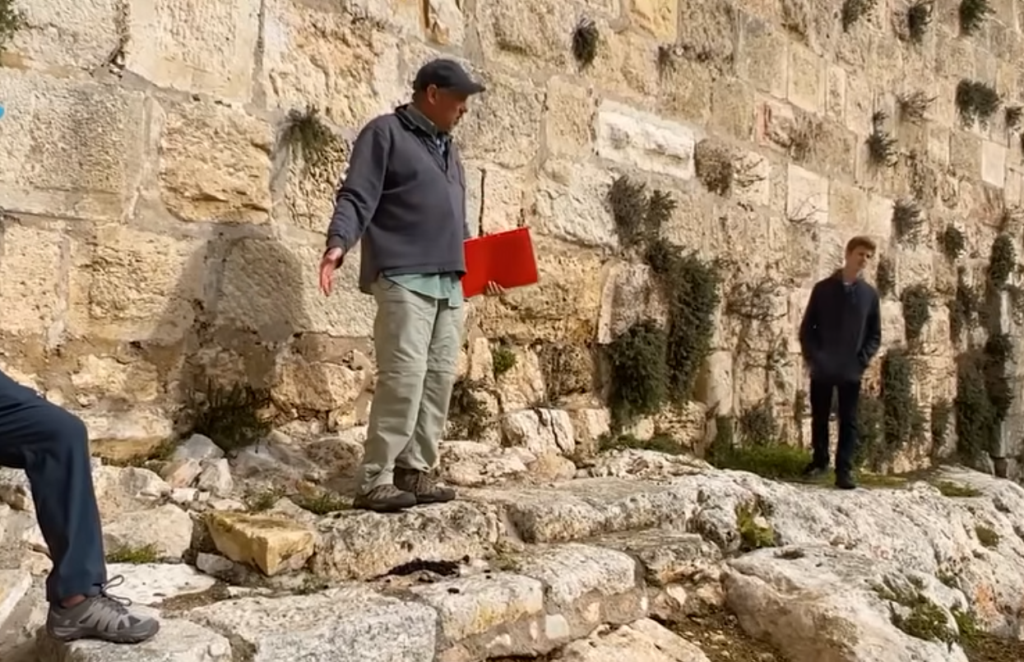
Until the mid-1970s, Kramer explains in a video produced by Expedition Bible, the western city wall of Jerusalem was largely covered by dirt. But then archeologists set to work scraping away the layers and eventually discovered the wall enclosing what is believed to be the palatial first-century palace built by Herod the Great, who died about 30 years before Christ’s crucifixion. Historical sources such as Josephus endorse this viewpoint, while another first-century historian, Philo, confirms that Pilate would have dwelt in this palace at the time of the crucifixion.
Speaking about Jesus’ trial before Pilate, Kramer says, “There’s a lot of description in the Gospel of John that they’re going in and out – Pilate’s going in and out, he’s bringing Jesus in and out – so there has to be a gate.”
Kramer goes on to explain how only one gate was found along this wall. By that gate are remnants of a stone pavement, steps leading up to a platform, and a stone judgment seat upon which the ruler would have sat when trying a case. Ample room stretches out in front of this judgment seat, showing the area where the mob might have gathered to demand the release of the criminal Barabbas and the crucifixion of Jesus. Furthermore, this same gate leads directly to the country, a fact which matches the biblical description of Simon of Cyrene being grabbed to carry Jesus’ cross when he came into the city from the country.
In a separate video, Kramer explains how archeological finds and historical tradition also correspond with the biblical description of the crucifixion site and the nearby tomb from which Jesus emerged alive on the following Sunday. Just a few of these data points include archeological evidence that the site was once a garden and that it was outside another first-century city gate.
Today, many non-Christians sit back and consider Christianity a crutch for the weak, an unscientific system that can’t be verified by cold, hard facts. And sadly, many Christians, while believing in their heart the tenets of their faith, remain ungrounded and unaware of the solid historical, geographical, and archeological evidence which testifies to the reality and truth of that faith. Both examples perfectly display the truth of which the Jewish prophet Hosea spoke, “My people are destroyed for lack of knowledge.”
This Easter, we should heed that challenge, determining not to be one of the many who shipwreck – or never consider belief at all – just because we haven’t taken time to go deeper and examine the evidence for the biblical record that’s right there waiting for us.
—
This article was made possible by The Fred & Rheta Skelton Center for Cultural Renewal.
Image Credit: