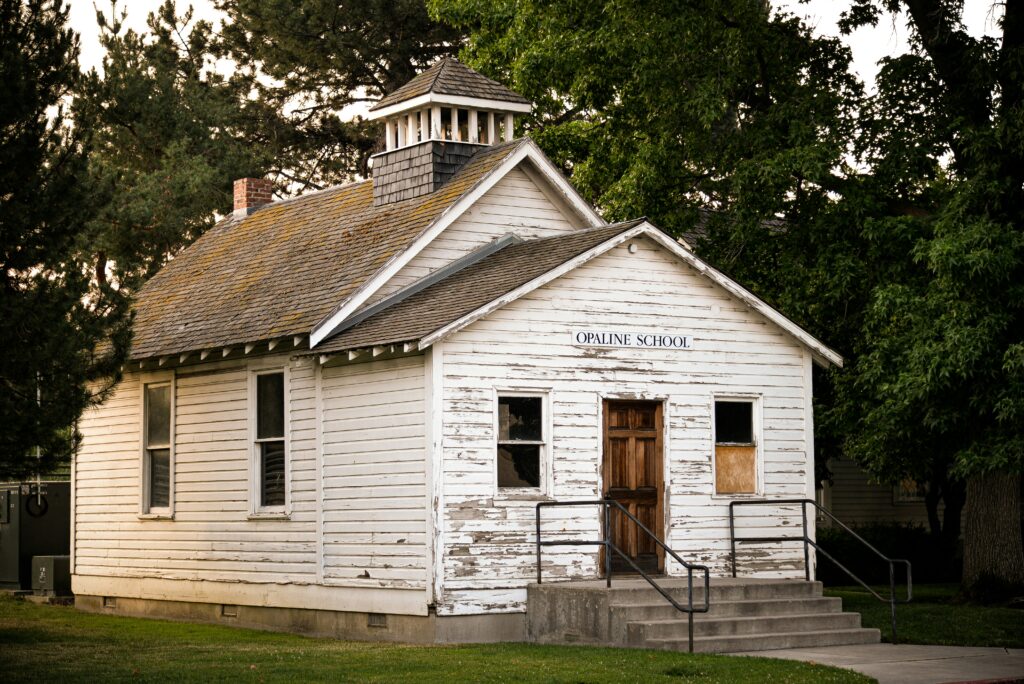
My grandfather attended a one-room schoolhouse as a child, although he sometimes was thrown out for smelling like the skunks he pulled from his trapping route on the way to school. He made some good money checking his traps on the path to and from school, paid by Sears, Roebuck and Co. for the pelts of skunk, mink, fox, and coyote. His trapping venture became a part of his education, albeit somewhat against the teacher’s wishes.
The idea of a one-room schoolhouse sounds quaint today. Yet a version of this classic educational model might be the future of alternative education, and its popularity is swelling throughout the country.
The modern reimagining of the one-room schoolhouse is called a “microschool” or “learning pod.” These are small-scale, usually private, versatile, learning structures that serve fewer than 20 students, which customize the curriculum to fit individual students’ needs and the needs of the community. These schools also aim to trim away the inefficiencies or ideological biases of the public system.
Microschools vary significantly in terms of their pedagogical approach, organization, and mission, but they generally share common features like flexibility, reduced schedules, varied locations, personalization, emphasis on hands-on learning, streamlined administrations, reduction of standardized testing, and lower cost than traditional private schools. Microschools are sometimes described as a blend between homeschooling and traditional schooling.
Parents and teachers have a variety of motives for starting microschools, but common ones include dissatisfaction with the assembly-line, one-size-fits-all style of learning in public schools; an interest in niche educational philosophies like Montessori or classical; a desire for greater parental control and involvement in the educational process; and a desire for more family time and flexibility in the family schedule.
Instructional Empowerment reviewed numbers of parent surveys, finding that the number one reason parents are choosing microschools is to achieve a more personalized, less “institutional” learning experience for their children. Other reasons included less standardized testing, more focus on developing the whole child, stronger sense of community, and less bullying and safety issues.
One national microschool organizer, Prenda, explains the connection between microschools and the historical one-room schoolhouse. Back when “[w]e had small towns and families spread out on farms- several families would come together and pay a teacher to lead a small group of age-mixed kids. We called this ‘the one-room schoolhouse.’” Prenda continues, “If the parents didn’t like what the teacher taught, they were fired, and a new teacher was brought in.”
That changed with the industrial revolution and largescale urbanization. “When the Industrial Revolution occurred, and people moved off of farms and into cities, public education was established and formalized, classes got big, and parents lost control.”
This largescale industrial education has been the dominant model ever since. “With microschools,” Prenda notes, “we are getting back community-driven grass-roots education that meets the needs of the individuals instead of the masses.”
Of course, the fact that microschools are based on an older model doesn’t mean they’re unable to adapt to new methods or technologies. On the contrary, microschools can innovate more quickly and effectively than the behemoth traditional schooling system that – encumbered by systemization and bureaucracy – moves at a glacial pace. “One strength of microschools is their ability to innovate rapidly,” Michael Matsuda notes at EdSource. “Unlike public schools, which are often bogged down by layers of bureaucracy, microschools can implement new teaching methods, curricula and integrate technologies quickly.” This is part of their newfound appeal. Parents looking for alternative forms of schooling can try them out through the nimble structure of a microschool.
Microschools are sprouting up all around the country – approximately 95,000 of them, serving at least 2% of the U.S. student population. That equates to about 750,000 students, although some estimates put the number up to 2 million fulltime students. An even larger number of students attend one of these schools part time.
This growing movement represents an exciting new era in American education history. The story of the microschool is the story of how something old can be made new again, and how the adaptation of a traditional model to a modern circumstance can provide a solution to contemporary problems.
—
This article was made possible by The Fred & Rheta Skelton Center for Cultural Renewal.
Image credit: Unsplash