
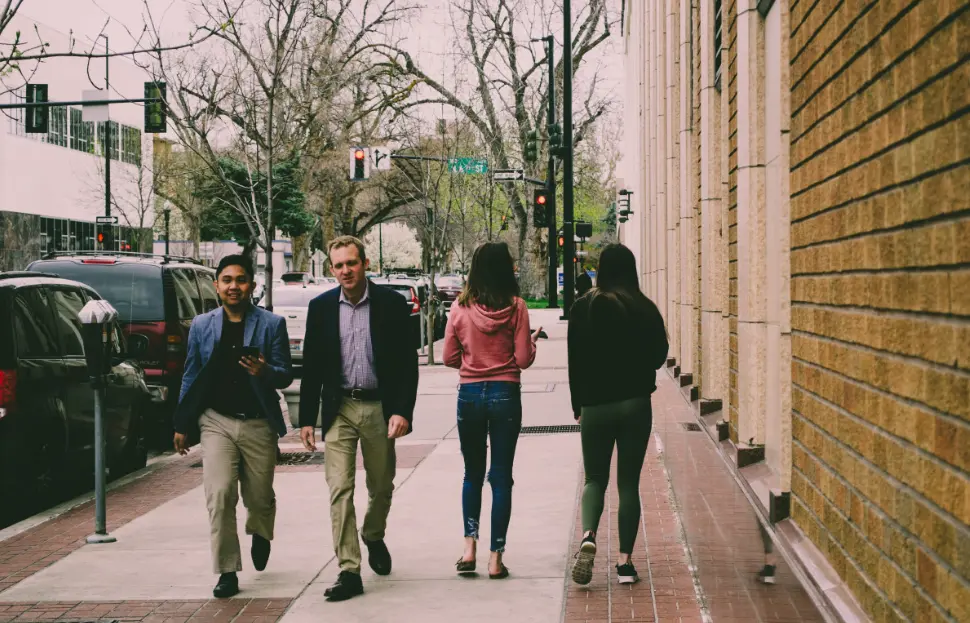
Imagine you are strolling along your downtown sidewalks. To your left you see a vacant lot overrun with weeds. The street to your right isn’t safe and needs to be avoided. A fellow across the block is using hard drugs in broad daylight. There are loads of shuttered buildings and, besides you, very little foot traffic. You might even notice that the dearth of foot traffic seems related to the fact that 30% of downtown is dedicated to surface parking for cars.
So you ask yourself, “When is the World Economic Forum gonna get its act together so we can have nice sidewalks and maybe a downtown where I can bring my kids?”
Most of us have encountered a relative at the Thanksgiving table, a coworker in the lunchroom, or someone in the barber shop who expounds on theories about a globalized cabal being the source of middle American decay. I won’t comment on the veracity of these theories; indeed, there may even be some truth to them.
But while most Americans wouldn’t go so far as to pin all our woes on what happens in Davos, they do act as though the problems closest to us must be fixed by folks at least as far away as Washington. We act this way when we religiously listen to podcasters and cable news anchors give updates on congressional races in states we have never visited. Those who hang on to every word of these podcasters, however, have likely never attended a local city council meeting.
Now, I understand that media folks are entertainers, while local city council meetings are often about as exciting as watching paint dry. But the fact remains that the decision to have construction on the street in front of my apartment for not less than 10 consecutive months was not made in Davos or D.C. It was made in my own city.
I don’t believe we should abandon national politics or retreat into quietism. Yet I do find it unnatural to care passionately about the global agenda while leaving our downtown streets to somebody else’s decision-making.
Yet there are reasons why this inversion of priorities is understandable.
As previously mentioned, the stakes in national elections can be larger and therefore more entertaining. The legislative apparatus behind the centralization of American life – something unthinkable to many of our founders – was built steadily over the last 250 years, accelerated by periods of massive upheaval that fundamentally altered the American political system – Reconstruction and FDR’s New Deal, for example. And new technologies like the car, the television, and the iPhone have rendered mass centralization possible.
Thus, after 250 years, Americans no longer share the intensely local character of our forefathers. There was once a time when state office was not viewed merely as a steppingstone to Washington, but as a position of genuine authority and prestige in its own right. In the early republic, governors, state legislators, and local political leaders often wielded more direct influence over daily life than distant federal officials. John Jay himself resigned as chief justice of the Supreme Court to become governor of New York, indicating that he believed the governorship was the more meaningful office.
Though this is unthinkable in today’s political landscape, it makes intuitive sense because the farther away from the locus of ordinary life a power center becomes, the weaker and more abstract its authority becomes. A school board will always have a greater effect on your kid than the president because they put real books in your brick-and-mortar library and make decisions about the classroom down the street. A father will always have more authority in a home than the school board by virtue of being the head of his house. The only way centralization becomes possible is when lower levels of authority abandon their posts.
Today, many Americans can name senators from other states more easily than members of their own city council. We know the voting patterns of counties in Pennsylvania or Arizona while remaining completely unaware of the zoning decisions reshaping our own neighborhoods.
I commend to you the principle of subsidiarity. The level of authority closest to an issue not only has the most practical power to address it, but also the most natural right and responsibility to address it. Americans were given a system by our founders that understood and respected this principle. The local meetinghouse and the church were once the center of our common lives, and the concept of federalism is predicated upon this reality.
What is needed now is a recovery of a preference for politics in the local – where you know people face-to-face, where you can have an immediate impact. The place you actually live.
This is part of why I believe in local news publications. It is also why I think it is our duty as Americans to get out to city council meetings – maybe even run for local office.
Because our sidewalks need fixing.
—
This article was made possible by The Fred & Rheta Skelton Center for Cultural Renewal.
Image credit: Pxhewre

























Leave a Comment
Your email address will not be published. Required fields are marked with *