

Recently I did something I haven’t done since childhood – if then.
On Oct. 2, I finished reading a novel. On Oct. 3, I started reading the book again, completing this second reading six days later. I never read for hours at a time, but only during breaks from work and my routine.
The first reading of these 376 pages overwhelmed me with a volcanic mix of thoughts and emotions. The second brought a more profound understanding not only of the power of storytelling at its best, but of myself, the people around me – both familiars and strangers – and of the contrast between the book and the cynicism and disillusion that mark our new century.
Stripped to its essence, Allen Levi’s “Theo of Golden” tells of an 86-year-old man, Theo, who shows up in the fictitious Southern city of Golden and changes the lives of the people he meets. But this is not a book review. If you want that, search out reviews online or go to Amazon and read the synopsis. On that site, you might note that “Theo of Golden” has garnered tens of thousands of ratings and reviews. Clearly, I am not alone in my evaluation of this novel.
No, what I intend here is a brief look at the transformative powers of a tale well-told.
One example from my past is Mark Helprin’s “A Soldier of the Great War.” More than 30 years ago, a friend recommended my son read this story of Alessandro Giuliani, an Italian with a passion for aesthetics, art, and beauty, who is swept up in the savage fighting of World War I. I read the book as well and found in Alessandro an adult version of the heroes I’d read about in childhood. Here was no modernist antihero lacking in character, but a figure of robust virtue worthy of emulation by young men. As an old man, Alessandro acts as a mentor, tethering his experiences to thoughts on art, beauty, war, death, manhood, tragedy, comedy, and even God. “A Soldier of the Great War” was several cuts above most fiction I was reading at that time, and time and again I’ve reread portions of this masterpiece.
And now along comes Theo, another old man as full of memories as an attic trunk. Because of the variety of people Theo meets – from Ellen, the homeless woman, to Tony the bookshop owner, to Asher the artist – this book also directs us to ponder the big sky topics of life, like the arts, music, and painting in particular, sadness and joy, the power of forgiveness, and the possibility of a Creator who moves in our lives.
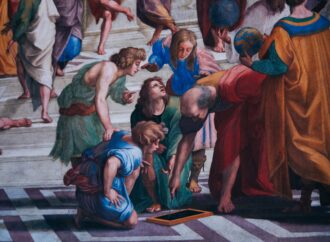
“Theo of Golden” is also a study of the human face. In the Chalice coffee shop, which becomes one of Theo’s favorite stopping places, hang 92 of Asher’s pencil portraits of customers for sale, which Theo buys in small numbers and returns personally and privately to their “owners,” the subjects of the drawings. Each gifting of these portraits produces remarkable revelations in the recipients, gently guided by Theo’s astute questions.
In an age when so many stare into a screen rather than look into a human face, this encounter comes as a revelation to readers as well. As Theo notes in a letter to Asher, “It is an imponderable thought that the Giver of Faces, the face of heaven itself, the face for which every heart yearns, became a wee babe, misty-eyed and helpless, looking Himself for the tender face of His mother on the night of the angels.”
And just as those portraits lead their “owners” to cast themselves in a different light, so “Theo of Golden” acts as a mirror for the reader, encouraging us to look into our own eyes and faces, and those around us, with a more intentional desire for understanding.
Now, a note to my readers here: If you are expecting from the excerpt above a conventional Christian novel in “Theo of Golden,” let me disillusion you. This book invites us to reflect on faith and God, profoundly so at times, but like other great classics of literature, such as Dostoevsky’s “The Brothers Karamazov” or C. S. Lewis’s “Till We Have Faces,” until almost the end of the story, Levi’s approach in this regard is subtle, as is so often true of the Creator Himself.
One more note of warning: Sometimes the right book comes into our lives at precisely the right moment, speaking to us from print and paper like a wise friend, and pointing us to try a little harder to pursue the better angels of our nature. While this was the effect of “Theo of Golden” on me, others may find it just another novel, a story consumed and soon forgotten.
All this to say, books like “A Soldier of the Great War” and “Theo of Golden” make me look harder at myself and push me to become a better person.
At any rate, pour your favorite beverage, keep at hand some just-in-case tissues for tears, and give “Theo of Golden” a try.
—
This article was made possible by The Fred & Rheta Skelton Center for Cultural Renewal.
Image credit: Unsplash























Leave a Comment
Your email address will not be published. Required fields are marked with *