
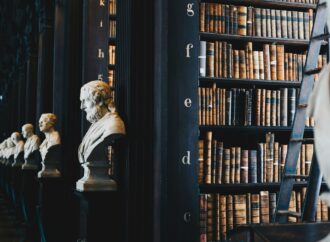
When I was a child, my parents built a library with 15-foot bookshelves, which, as it turned out, weren’t large enough to hold all my father’s books. His desk and armchair were surrounded by a forest of stacked volumes so that you had to navigate carefully to make it through the room.
I caught his enthusiasm. In my post-college life, I crammed eight boxes of books into a studio apartment. Later, I strained relationships with friends who offered to help me move. They didn’t know till they arrived at my apartment that they’d be carrying those boxes down a fire escape two stories high.
In my current home, one wall of the living room is literally covered with books – and it’s not the one with built-in bookshelves. (Those are also full of books.) Our guest room doubles as a library. Hymnals sit on top of the piano. One kitchen cabinet houses cookbooks instead of dishes. My daughter sleeps with stacks of books at the foot of her bed, and there are usually books on the floor of the car.
In terms of time, money, and storage space, books have been one of the largest investments of my life. If I lived in the Middle Ages, when Bibles were so valuable they were literally chained to the pulpit, the investment might make sense. Yet in the internet age, my collection of books seems quaint at best or, at worst, irresponsible. If I need to look something up, the internet is more convenient. If I want to be entertained, YouTube and Netflix will oblige. Yet, I still collect books and find places to store them.
What possible reason is there to put up with this inconvenience? Is it because reading on paper is better than reading on a screen, both for our eyes and memory? Is it because I like the way books look with their spines all facing out? Or is it because I’m building an “anti-library,” a collection of books to remind me how much knowledge there is in the world and how little of it I have learned?
The answer to all three questions is yes. But none of them really satisfies the charge most commonly leveled at printed books, which is that they are hopelessly inconvenient. I admit this. In fact, I embrace it. There are some things in life that are valuable despite their inconvenience. Books are valuable (in part) because of their inconvenience.
Creating, shipping, housing, and even using physical books costs time, money, and effort, but this investment is what makes books so valuable. Sixth-century Irish monks spent hours copying manuscripts by hand – one, famously, staying up all night to do so – and, later, when they evangelized Europe, they carried those books with them tied with rope around their waists. Would an Irish monk have traded his books for an iPhone with internet access and the Kindle app? No, I don’t think so, because the time spent with and around books – copying them, reading them, re-reading them – made them precious things. An iPhone, despite its inconvenience, has no lasting value. It is too easily replaced.
A few months ago, several libraries at Massachusetts Institution of Technology (MIT) were permanently closed. Presumably, those who hold the purse strings decided the buildings were worth more to the university empty than full of books. In a faculty newsletter, Dr. Elizabeth Cavicchi reminisces on the time she spent among the stacks at the university’s Barker Library. It’s plain that losing access to books is only part of the reason she misses the library so much. If all she cared about was getting a specific book, an internet database, combined with delivery from an off-campus storage facility, would be more efficient. Instead, Cavicchi describes her time in the library as anything but convenient.
As a student and researcher, I walked and searched around and around Barker’s circularly arranged stacks (often traversing the entire perimeter to find some specific book or journal). Having first walked among the card catalogue stacks, opened drawers, flipped through cards and written down book’s LC numbers, I went up and down stairs, in all the MIT libraries, seeking out widely separated LC locations. Those peregrinations had me stop spontaneously, notice something unconsidered, and add to and carry heavy piles of books and journals to a table, xerox or scan station, or circulation. In those physical experiences, balancing drawers, searching among shelves, climbing stairs high and low, carrying heavy volumes – the learner is continually re-impressed by the vast extent of human writing, researching, and expression, that has been the grounds, the work and the process of investigation and knowledge across history.
Walking, searching, opening drawers, carrying heavy volumes… nothing about this process is efficient or convenient. When you do research on the computer, you don’t traverse the perimeter or go up and down stairs. You don’t use words like “peregrination.” You search for something, find it, and go about your day. And when you can’t find something online, or when looking for something online takes longer than you thought it would, you don’t find yourself “continually impressed by the vast extent of human writing, researching, and expression.” If anything, you wish people would stop expressing themselves.
If you want to keep yourself in awe of human knowledge and creativity, you’re going to have to put in some effort. Physically walking through a library or bookstore makes a greater impression than watching views accumulate on a popular YouTube video. Carrying a physical book onto an airplane, instead of making do with a weightless app, shows that you value its contents. If you believe the output of human creativity is worth something, make room for it. Embrace the inconvenience.
—
This article was made possible by The Fred & Rheta Skelton Center for Cultural Renewal.
Image credit: Picryl
























Leave a Comment
Your email address will not be published. Required fields are marked with *