
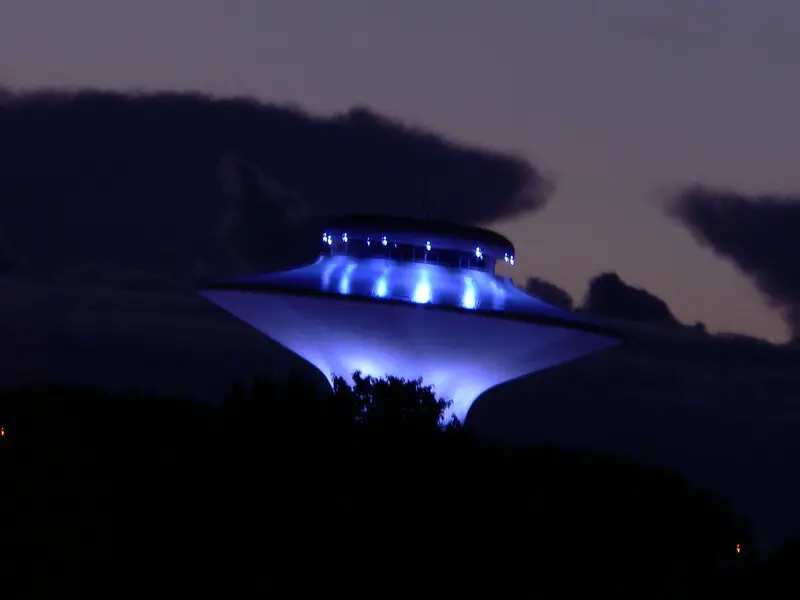
I’ve been following the UFO beat for more than 10 years. But my interest in it probably didn’t start the same as it did for most people. For me, it started with listening to what a musician had to say on the subject.
Tom DeLonge, best known as the frontman for Blink-182 and Angels & Airwaves, spent years claiming that the government had more information about unidentified aerial phenomena (UAPs) than it was letting on. At the time, most people wrote him off. Many still do.
But in December 2017, the New York Times ran a front-page story confirming the existence of a classified Pentagon program called the Advanced Aerospace Threat Identification Program. DeLonge’s organization, To the Stars Academy of Arts & Science, had worked directly with former intelligence officials to get the story published. That’s when the long-standing stigma around the subject started cracking.
Since then, I’ve kept up with the growing number of witness testimonies, the declassified video footage, and the investigative reporting coming out of this field. What once was reduced to the fringes of late-night radio has now migrated to Senate hearings, sworn congressional testimony, and primetime news.
The public is noticing. A 2026 CBS News/YouGov poll found that 8 in 10 Americans believe that the government knows more about UAPs than it’s sharing with the public. It’s safe to say that the subject is not fringe anymore. Rather, it’s the majority view, held across party lines, age groups, and even education levels. Even those who aren’t convinced that we’ve been visited by extraterrestrial life are convinced that the government is concealing something.
The current administration has not done much to discourage that suspicion. Under the Trump administration, the Pentagon began releasing previously classified UAP files. Investigators who reviewed the records warned that the public will be shocked by what they find, and that the disclosure process has already gone too far to be walked back. Former military intelligence officer Luis Elizondo and investigative journalist Ross Coulthart have both intimated that the release of important information on the subject is imminent. These are highly reputable people who have, throughout their careers, worked to move information from classified channels into the public record.
It appears that the scientific community is bracing for impact as well. Just this month, the International Academy of Astronautics approved a major update to its protocols for evaluating and communicating evidence related to extraterrestrial intelligence. The revision was specifically designed for the current information environment – one shaped by social media, widespread deepfakes, and a 24-hour news cycle capable of amplifying a single unverified claim into a global panic. Additionally, the uNHIdden Foundation published updated guidelines for public preparedness in the event of official disclosure. Scientists and mental health advocates are treating the possibility of disclosure as a legitimately serious and viable possibility.
Popular culture is also keeping pace. Steven Spielberg’s “Disclosure Day,” which opened in theaters on June 11, poses the question: If someone were to show you undeniable proof that we’re not alone, would that frighten you? Spielberg has played in this territory several times before, with “E.T.” and “Close Encounters of the Third Kind” – both of which explored alien contact. However, both films imagined the premise as mere science fiction. “Disclosure Day,” on the other hand, has been produced in a climate where alien contact is being considered in earnest.
“I don’t know any more than any of you do, but I have a very strong suspicion that we are not alone here on Earth right now—and I made a movie about that,” Spielberg said at SXSW in March 2026.
What changed between Spielberg’s earlier alien flicks and this one is the same thing that changed between 2017 and now – the conversation around alien life has gone beyond merely hypothetical. Navy pilots, under oath, have sworn before Congress. The Defense Department has acknowledged video footage of objects it couldn’t readily identify. Whistleblowers have come forward, and under legal protections, written for this subject. The architecture of official denial has been visibly crumbling for nearly a decade.
I’m not prepared to defend the notion that the government may have alien spacecraft in a warehouse somewhere. What I am suggesting, however, is that the argument for government transparency around this subject isn’t being made by people walking around in tinfoil hats. The people asking questions about these things are those who have earned a reputation of being highly trustworthy, thorough, and professional.
The federal government has kept significant information from the public at different times throughout its history, including the Church Committee, the Pentagon Papers, COINTELPRO, MK-ULTRA, the Tuskegee experiments, and the Star Gate Project, which looked into the militaristic benefits of remote viewing. None of these were conspiracies. These are well-documented programs, confirmed only after years of institutional resistance. Of course, none of these suggest that the government is concealing alien spacecraft. But it does mean that we should question what’s out there.
The UAP question doesn’t require us to believe the extraordinary. However, it asks that we consider what history has already established, which is that government secrecy is real, and that, sometimes, it continues long after the point of justification.
Ten years ago, the UAP story was something that got a lot of eye rolls. But now, no matter what your view on the subject is, we all must admit that it’s a story worth taking seriously.
—
This article was made possible by The Fred & Rheta Skelton Center for Cultural Renewal.
Image credit: Flickr-Jonas Bengtsson, CC BY 2.0






















Leave a Comment
Your email address will not be published. Required fields are marked with *