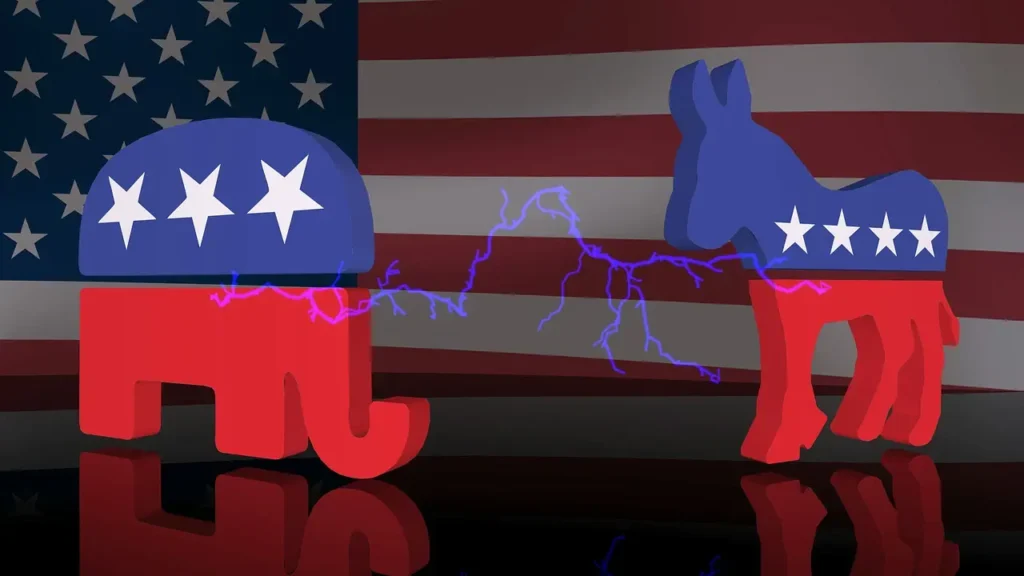
Political polarization in America – what drives it? One often-overlooked factor is simple misunderstanding – or, to use the technical term, the “perception gap.” This term refers to the significant gap between what one party thinks the other party believes and what it actually believes.
According to “Perception Gap” research conducted by More in Common (MiC), a nonprofit organization dedicated to healing political polarization, we tend to significantly exaggerate the extremity and hostility of an opposing political party’s views.
Commenting on the findings of the “Perception Gap” study, Research Manager Paul Oshinski observes, “After four years at More in Common, the most powerful insight I’ve gained is the ‘perception gap.’ No other concept so profoundly challenges the assumptions we make about those whom we disagree with politically.”
MiC studies this phenomenon by asking Republicans, Democrats, and Independents what percentage of the other party agrees with a certain statement. For example, MiC might ask Republicans and Independents what percentage of Democrats would agree with the statement, “Law abiding citizens should have the right to bear firearms.” Then, they ask Democrats the same question to discover what the group really thinks. The difference in percentage points between the two results is the perception gap.
Other issues examined in this way include patriotism, climate change, sexual assault, police conduct, American history, racism, and immigration.
The upshot? Americans misjudge each other.
Democrats and Republicans typically overestimate the percentage of opponents who hold “extreme” views by a factor of two. The estimated proportion of the opposing party believed (by the other party) to hold extreme view is 55%. But the real number is 30%. This means, as MiC points out, that even on the most controversial questions facing our nation, we’re less divided than we think we are.
“These perception gaps matter because they represent a fundamental misunderstanding of our fellow Americans,” Oshinski writes. “When we misunderstand each other, we are less likely to engage, more likely to distrust, and more prone to seeing politics as a battle rather than a shared project.” One byproduct, as Oshinski notes, is an unnecessary cycle of escalation: as one party exaggerates the extremity of the other, they respond by nudging their own position further in the opposite direction.
Here’s a brief look at the perception gaps between Democrats and Republicans, respectively:
Democrats

Republicans

These charts reveal a rather different story from what we might expect. While Republicans assume that only about 30% of Democrats disagree with the statement, “The US should have completely open borders,” the real number is closer to 75%. Meanwhile, Democrats presume that only a little over half of Republicans believe that properly controlled immigration can benefit the country, but the true number is more like 85%.
One of the largest perception gaps has to do with views on history, with 93% of Republicans believing America has a responsibility to learn from its past. Democrats, however, assumed this figure was only 35% – a perception gap of 58 percentage points.
Why such large perception gaps? One answer has to be the media. The loudest voices tend to get the most attention in today’s attention economy, and those voices are likely to be the most ideologically extreme ones. Strongly conservative or ultra-liberal news outlets hammer back and forth at each other, dominating the national conversation and consistently demonizing the other side.
Thus, the average American is constantly both hearing extreme positions articulated by pundits for clicks and hearing those same pundits describe the opposition in extreme (and perhaps untrue) terms. This naturally affects the average American’s perception of people across the aisle.
As Oshinski explains, MiC’s research unearthed the fact that Americans who consume more partisan news and have more news consumption in general have wider perception gaps when it comes to understanding the other party. Similarly, frequent social media use is correlated with higher perception gaps.
Oshinski also notes that social media isn’t actually representative of the way most Americans think. This is because, according to research from New York University:
[T]he people who post frequently on social media are often the most ideologically extreme. … [A]bout 90% of the population’s political opinions are being represented by less than 3% of tweets online. … This renders moderate opinions effectively invisible on social media, leaving the most extreme perspectives most visible for users.
No wonder we’re divided and at each other’s throats.
None of this is to say that real differences don’t exist between the parties. This isn’t some Pollyanna-esque claim that we’re all the same and part of one big, happy family. American political parties have starkly different perspectives on some really important topics.
At the same time, it isn’t helpful to exaggerate differences. For one thing, we end up debating the wrong issues. Rather than addressing our actual differences – which are real – we rage over imagined differences, fencing with phantom opponents who don’t really exist. We think half the nation believes something to which only the fringe would adhere. So we end up fighting the wrong battle and drifting further away from the average Americans surrounding us.
Overcoming perception gaps isn’t easy. But it likely begins with learning to listen again, even when we genuinely disagree with someone. And sometimes, through that listening process, we realize our disagreement isn’t as profound as we initially assumed, trained as we are on the knee-jerk, rage-baiting, vitriol-filled social media discourse.
“Shifting from judgment to curiosity—seeking to understand why someone holds a view, not just what they believe—opens the door to more meaningful conversations,” Oshinski observes. “It also challenges us to consider how we want to be understood and how we can offer that same generosity to others.”
If we want to be better understood, we must first seek to understand.
—
This article was made possible by The Fred & Rheta Skelton Center for Cultural Renewal.
Image credit: Needpix.com
1 comment






















1 Comment
JCambias
August 6, 2026, 10:20 amOne other effect of the perception gap is that it breeds distrust and thus reinforces itself. When, to use the first example in the first chart, Democrats believe — and thus claim — that Republicans oppose all immigration, Republicans (who according to the chart don't oppose all immigration) see their opponents as telling lies about them. If someone is lying about you, can you trust them? They appear to be arguing in bad faith, so can you trust their promises? Can you trust them to follow norms? Not cheat? It just feeds itself.
REPLY