
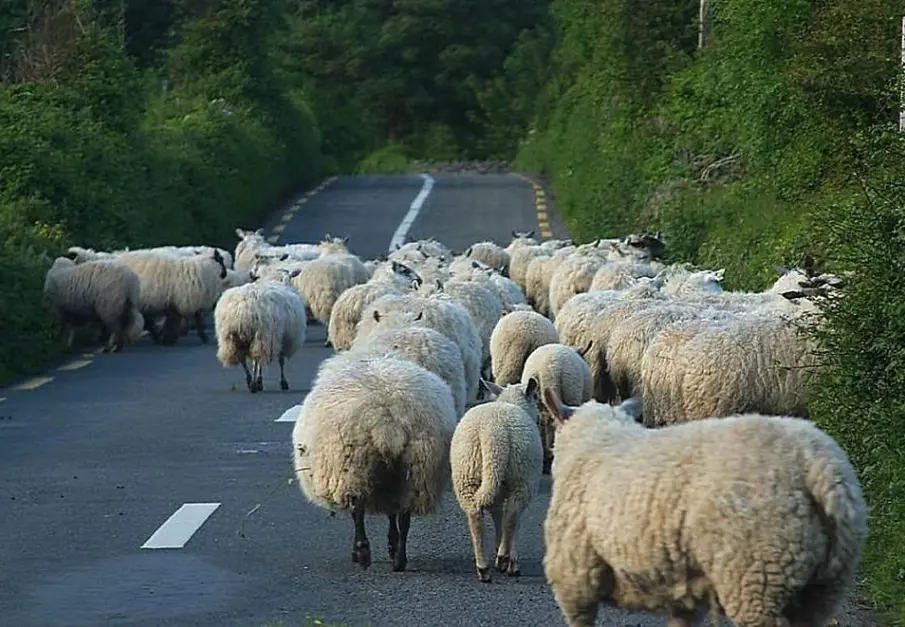
I have introduced some feral sheep to the countryside around my property.
Not on purpose, mind you.
One bright morning a few weeks ago, I was buckling my toddler into her car seat so we could go to church, when she observed that the sheep were on the wrong side of the fence. Twenty minutes of sheep chasing – my tie flapping about my shoulders, my brown dress shoes skidding across slick grass – and the result was that I stood breathless on the road, watching the hindquarters of three sheep recede into the distance. They turned off the road and climbed the hill before disappearing into the green depths of the woods to embrace their new life of freedom.
Watching helplessly, I didn’t realize right away that this was a dose of reality I needed.
Let me explain. Livestock, I have learned, rarely do what they’re supposed to do. Around the same time as the sheep fiasco, for instance, we had a calf born who insisted on trying to nurse from his mother’s neck wrinkles while ignoring her actual udder.
This kind of thing can leave the homesteader frustrated, shaking his fist at the rear ends of a flock of sheep or trying to force a calf’s head down toward a cow’s udder to do what should be perfectly natural to him. But – my frustration notwithstanding – I maintain that it’s a good thing that livestock often misbehave, particularly in the mechanized technological age we live in, an age that has all but convinced us that we’ve made nature into our slave.
When a flock of sheep pulls a Houdini or a dog won’t stop barking or a calf struggles to nurse, it reminds us of our limitations and the bewildering intractability of the natural world. It places us firmly in touch with a world that resists our efforts to control it, a world that always exists on the verge of slipping from our fingers. We encounter in a visceral manner something other. Something that is always a little inscrutable. Something that, because it is alive, cannot be fully quantified nor predicted.
This world – and, emphatically, it is the real world, more real the frictionless environment of pixels we spend so much time in – is a little like a sheep that will live peacefully and predictably inside a pen for months on end, never betraying its secret, all the while silently waiting for the right moment to throw off its shackles and break out into the hinterlands.
This unpredictability, this irrepressibility of real life can annoy us – or it can thrill us.
I assumed I would never see my sheep again. But about a week and a half later, they appeared in the field across from my house. I called an acquaintance with a sheep dog, and he showed up with his son and his Australian Shepherd in tow. When the sheep wandered into my neighbor’s yard, he got involved too.
We were like four desperados, chasing a treasure convoy through hill and valley. The man with the sheep dog was the expert gunslinger; his son was the rough and ready youth (the “Kid” as he’d be called in a John Wayne movie); my neighbor, an old retired dairy and beef farmer, was the grisly man of experience; and I was the … narrator, I guess.
After several failed attempts, we managed to encircle our quarry completely with a moveable mesh fence, and, inch by inch, drove them toward the trailer, utilizing all the cunning and training of the sheep dog and her master. I stood on a hilltop as the chill wind blew the scent of the marsh from the bottomlands below, taking it all in: the expanse of the valley, marbled green and gray and brown, the gray swales of cloud over the distant hills like the bellies of whales, and my pants and shoes soaked from crossing the swamp.
It beat sitting in my office all day, that’s for sure.
“She has them now,” I thought, looking down the hill as the sheep dog slowly moved the sheep toward the trailer. A few more feet and they would be in, and the boy would slam the door shut. Man, dog, boy, and sheep all stood still, tensed and ready.
But the sheep had one more trick up their sleeves. And by “trick” I mean the subtle art of bolting like maniacs.
The stillness fractured into chaos, sheep this way, dog that way, the man bellowing and staggering. The sheep broke and somersaulted through the temporary fence lines like it was paper mâché, disappearing into the tree line behind us.
There was no hope of catching them now.
Given our failure and the waste of three hours of our days, why, then, did we all grin at each other? Why did we feel so alive? Why did we feel like comrades in arms? All I can say is that, somehow, it was not a waste after all.
They’re still out there, of course. A trio of Shetland sheep, now battle-hardened, their war for independence won, surveying with steely gaze the domain they’ve claimed – which is to say, the whole of the county – or maybe, the world.
I like to imagine them wandering into some unsuspecting citizen’s yard – a silent, woolly reminder that all the vast apparatuses of human science have not yet fathomed everything, and all the vast machinery of human ingenuity have not yet subdued everything. Even our best-laid plans – our dogs, trailers, fences, ropes, and the rest – couldn’t put an end to dreams of independence.
The mind of the sheep remains a frontier unconquered by science and technology.
And I’m glad of that.
—
This article was made possible by The Fred & Rheta Skelton Center for Cultural Renewal.
Image credit: Pixnio

















Leave a Comment
Your email address will not be published. Required fields are marked with *