
Does religion make people happier? As writer and university teacher Stephen Cranney reported in 2024, the studies and literature on the connections of health, well-being, and religious practice are vast and demonstrate overwhelmingly that those active in a faith are generally happier than non-believers or those not involved in a religious community.
Many articles on this topic claim that such happiness stems from the sense of community a church brings and the support of like-minded friends. Doubtless there is truth in this assertion, yet few pollsters or commentators consider the effects of a religious worldview on one’s happiness: a prayer life, studying Scripture, the deepening of faith through reading other books, discussions of faith with friends.
Nor do pollsters distinguish happiness from joy, though the two are quite different. Happiness is short-term, often roused by external events; joy is long-term and comes from within. Like others, Christians may use these terms interchangeably, but the learned and devout recognize the difference between the two and know that joy rather than happiness is one of the great gifts of the Holy Spirit, a profound union with God which brings hope and inner peace even when life knocks us to our knees.
Some comments posted on social media in reaction to such studies of happiness range from positive agreement with the data and conclusions to attacks on Christianity and religion in general, like, “Drunk people are happier than sober people,” which is laughably false, or, “It’s all just part of the fairy tales.”
Which brings me to Easter, the consummation of a joy that began with the Nativity.
Even non-believers know the basics of this story, encapsulated in the Apostles Creed, that Jesus Christ “suffered under Pontius Pilate, was crucified, died and was buried; he descended into hell; on the third day he rose again from the dead; he ascended into heaven, and is seated at the right hand of God the Father almighty; from there he will come to judge the living and the dead.”
This is a foundation of Christian joy, that an all-powerful Messiah came to earth and broke the chains of death.
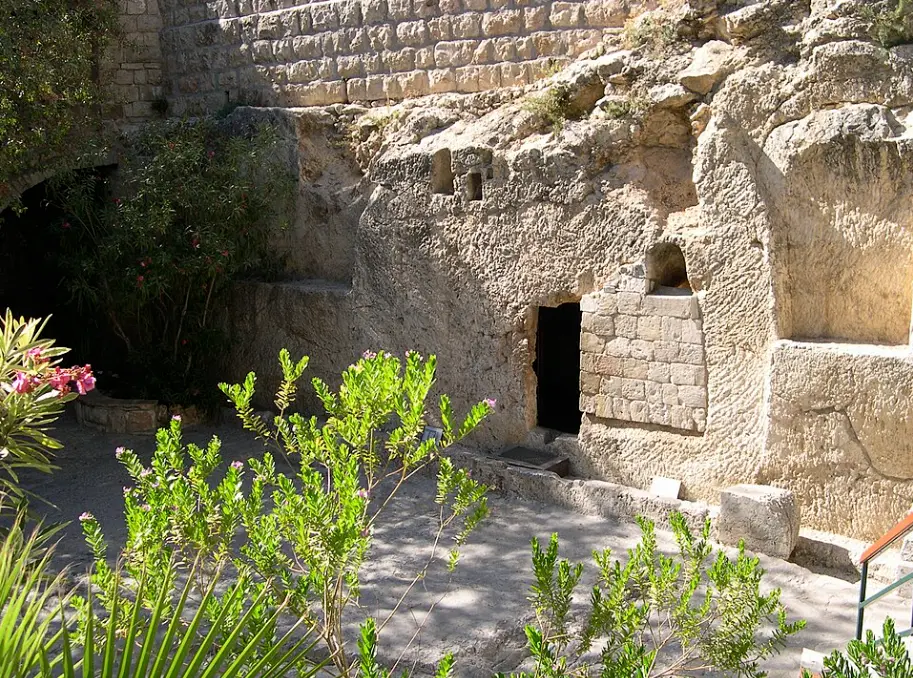
Of course, the full story of the Resurrection as told in the Gospels contains multiple details, including placement of Jesus’s body in a tomb sealed by a heavy stone. The story then goes that soon after the end of the Jewish Sabbath, some of his followers found the stone rolled away and the tomb empty.
I am no biblical scholar, but I do enjoy literature and stories, and here in this account of the stone and the tomb I see a tremendous metaphor. Plato’s Allegory of the Cave comes to mind, that renowned scene in “The Republic” which describes prisoners living in a cave who mistake reality for shadows cast on a wall. The narrator, Socrates, compares a philosopher to a released prisoner who escapes the cave and its shades and shadows, discovers in the sunlight the true nature of reality, and returns to tell the others. They refuse to believe him, and if released from their chains, would kill him should he try to lead them out of the cave.
In his resurrected form Jesus didn’t need the stone removed to escape the tomb. As the Gospels demonstrate, he could pass through material objects. Biblical commentators note that the stone was removed so that his followers could discover that the tomb was empty.
True, of course, but we might also view that sealed tomb as a metaphor for the place in which all human beings without faith live. Before the stone is rolled away and we are led into the light of faith, we live like Plato’s cave-dwellers, blind to truth, true beauty, and true goodness, fleetingly happy but without deep joy in living and better understanding the world. Faith rolls away the stone from the tomb in which we live and leads us into the light of Christ.
The resurrection consequently promises not only life after death, but life before death.
“There are only two kinds of people in the end: those who say to God, ‘Thy will be done,’ and those to whom God says, in the end, ‘Thy will be done.’ C.S. Lewis writes in “The Great Divorce. “All that are in Hell, choose it. Without that self-choice there could be no Hell. No soul that seriously and constantly desires joy will ever miss it. Those who seek find. To those who knock it is opened.”
This Eastertide, if you feel locked in that tomb, try knocking and see if the stone rolls away. Joy can be yours if you seek it.
—
This article was made possible by The Fred & Rheta Skelton Center for Cultural Renewal.
Image credit: Flickr-upyernoz, CC BY 2.0
1 comment























1 Comment
William Gillin
April 2, 2026, 5:06 pmSo true! Excellent article, Jeff. I had the privilege several years ago of visiting the Garden Tomb, which is pictured above. The "traditional" burial tomb of Jesus is covered by a large church in Jerusalem, and it is hard to picture what the original tomb might have been. The Garden Tomb, outside Jerusalem, was uncovered in the 1800s, and certainly looks like an original tomb carved into the rock. I felt a sense of awe and wonder, as I pondered whether this could have been Jesus' tomb. When I read the gospel accounts of Jesus' burial and resurrection, I can picture the Garden Tomb.
REPLY