

I’m Gen Z, a recent college graduate, and a newly engaged woman. I have a lot of life ahead of me, and hopefully, a lot to which I can look forward.
But it seems that everywhere I turn I’m met with such slogans such as: “The West is in decline”; “Millennials and Gen Z are selfish, foolhardy, and weak”; “There is no hope for the young”; “Nothing is as good as it used to be and nothing will ever be as good again.”
Or to put it more poetically in the words of John Steinbeck, “Strawberries don’t taste as they used to.”
This is not what a 20-something woman likes to hear.
In the noble quest to preserve and respect the traditions and successes of history, many tend to look back at the past with rose-colored glasses and toward the future with pessimism. Yet every age has its difficulties. Truthfully, there is no part of me that would prefer to live in the 1950s rather than the 2020s. I love having modern medicine, safe vehicles, Spotify, and the ability to make my own money. And while older generations love to tell me that everything is getting worse with each passing year, I prefer to face the future with optimism. Here are a few things that are getting better.
Divorce rates are down
In college, I took a class on “Sociology of the Family” and was shocked to learn that – contrary to that bemoaned in conservative circles – divorce is in decline.
”Since the early 1980s, the divorce rate has now fallen by almost 40 percent—and about half of that decline has happened in just the past 15 years,” my sociology professor and researcher Brad Wilcox wrote in The Atlantic in 2025.
The divorce rate peaked in the 1980s, meaning unprecedented numbers of millennials were raised in broken homes. Having divorced parents increases a child’s likelihood of divorce later in life. Yet there’s a positive flip side that’s showing up today in adult millennials, as they are significantly less likely to get divorced than their parents were. In fact, the divorce rate is currently the lowest it’s been in 50 years.
Marital success is on the rise
Another oft-quoted statistic is that the success of a marriage is 50/50, meaning marriages are equally likely to end in divorce as they are to last “till death us do part.” But the 50% rate has steadily declined over the last several decades, and those marrying for the first time are now only 40% likely to divorce. In other words, marriages are now more likely to succeed than to fail.
This success has a trickle-down effect, as children more likely to be raised in two-parent homes gain immense social, academic, and mental-health related advantages.
Millennial fathers are more active in their children’s lives than fathers of any other generation
In families that adhere to traditional gender roles, mothers are far more involved with their children than fathers, who spend more time at their day jobs than with their families. Yet according to Pew Research, the amount of time that American fathers spent with their children almost tripled between 1965 and 2011, rising from 2.5 hours per week to 7.3.
Since the COVID-19 pandemic of 2020, however, fathers of children ages 10 and under spend 1.2 more hours on childcare per week than they did previously.
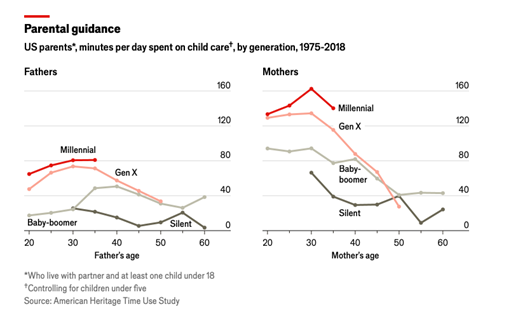
In fact, as the graph below demonstrates, each subsequent generation of fathers spends more time on childcare than their predecessors – so it’s likely that Gen Z fathers will be more involved with their children than ever before. An entire generation of fathers who prioritize parenting and quality time with their children is a huge win.
Binge drinking is going out of style for Gen Z
Compared to their millennial and Gen X predecessors, alcohol consumption among Gen Z has decreased markedly. Fewer high schoolers drink than in previous generations, “marking a 43% decline since 2015 and a 69% decrease since 1991,” according to Psychology Today. The year 2023 marked the lowest binge drinking rate among college students since 1980.
Gen Z is more suspicious of technology and social media
In spite of high screen time and phone addictions, Gen Z is aware of the dangers of too much social media, with up to 50% admitting that they wish certain social media platforms like TikTok and X “had never been invented,” and “would not or will not allow my child to have a smartphone before reaching high school age.”
Will Gen Z parents put an end to the “iPad kid” generation? Having grown up with more technology access than ever before and being the first generation of children to get hurt because of it, it’s highly likely.
And while AI use grows ever more prevalent, I don’t know a single person my age who lacks reservations about it. This may be attributable to those with whom I surround myself, but even so, my friends from all angles of the political spectrum are anti-AI because of threats to the environment, danger to the arts, ethical dilemmas, and religious dilemmas.
There is no “ideal” era
It’s never been easy to be human. No decade or century has been perfect. Indeed, most have been marked by despair for the next generation – consider, for example, how many regarded the advent of the radio as the decline of civilization, intellectualism, and family life.
But we should also remind ourselves that we are moving past the rampant alcoholism of the early 20th century, the social media addictions of the 2010s, and the children who hardly saw their fathers throughout the last few centuries.
In the end, pessimism shouldn’t prevent us from gratitude for the myriad ways that society is quietly improving in important ways.
—
Image credit: Unsplash

























Leave a Comment
Your email address will not be published. Required fields are marked with *