
When I was about seven years old, I begged my parents to let me watch “Hannah Montana,” a favorite among some of my friends. My parents held their firmly negative stance despite my pleas.
At a friend’s birthday party, though, the TV was turned on as background noise, and “Hannah Montana” happened to be on Disney Channel. I sat on the couch and stared fixedly at the screen, wonderstruck. I remember nothing about the episode except that I was mesmerized by the sparkly world of public school, crushes, musical fame, and teenage attitude that Miley Cyrus’ character inhabited.
“Hannah Montana” is a good television example of what educator Charlotte Mason called “twaddle.” Merriam-Webster defines “twaddle” as “silly idle talk” or “something insignificant and worthless.” In Mason’s writing, twaddle refers to stories and books which are perhaps harmless, “reading-made-easy” on the surface, but are in truth “scrappy” and “weak” material.
Instead of twaddle, Mason famously encouraged the use of “living books.” While Mason does not outright define living books, as a category they represent “worthy thoughts, well put; inspiring tales, well told.” They are works not of mere entertainment but of “intellectual fibre” that delight the soul. The contrast between twaddle and living books extends beyond literature, as “Hannah Montana” evinces.
In his recent book “Love What Lasts,”classical educator Joshua Gibbs echoes Mason, denouncing our culture’s pervasive “spectacular, highly sensual, fashionable, and easily disposable” junk food for the mind and soul. Gibbs encourages instead that we build our intellectual diet from the “common” fare of good, simple stories and artwork and from the “uncommon” fare of the Great Books, composers, and artists. Both common and uncommon have their place, but, like Mason, Gibbs gives no place to easily disposable twaddle.
Our culture, nonetheless, prepares us to love not what lasts but what is empty and fleeting. As I recently wrote, our culture is increasingly shaped by something beyond twaddle: pornographic and otherwise smutty media. While young men are especially vulnerable to pure pornography, young women are the target of a much more socially acceptable and emotionally manipulative form of pornography in modern romance media, as the recent remake of “Wuthering Heights” exemplifies.
How did we get here? Plausible answers abound: the 20th and 21st centuries have seen the gradual loosening of moral standards and etiquette. The sexual revolution popularized promiscuity and challenged chastity. The unceasing march of technological advancement permits the worst of human instincts to be broadcast everywhere.
All these realities contribute to our culture’s current obsession with dark, explicit stories. Still, I think that any sufficient explanation of the popularity of smut must also rest upon the popularity of twaddle. Since twaddle, however fun and innocent, shapes and defines our cultural imagination, we accept smut.
Much of the media marketed for children and teens today is trash in terms of true “intellectual fibre.” Its primary goal is distraction and entertainment rather than the expression of beauty or the pursuit of wisdom and solid formation.
Twaddle is more obvious or heinous in some cases than others, but it is ubiquitous all the same, pervading households both progressive and conservative.
While twaddle has been around for centuries – Mason saw it everywhere in the 1800s – screen-based media allows for its magnified propagation. The ubiquity of such vapid media makes smut seem less offensive or improper. When entertaining trash is the norm, poisonous, pornographic trash seems of little consequence.
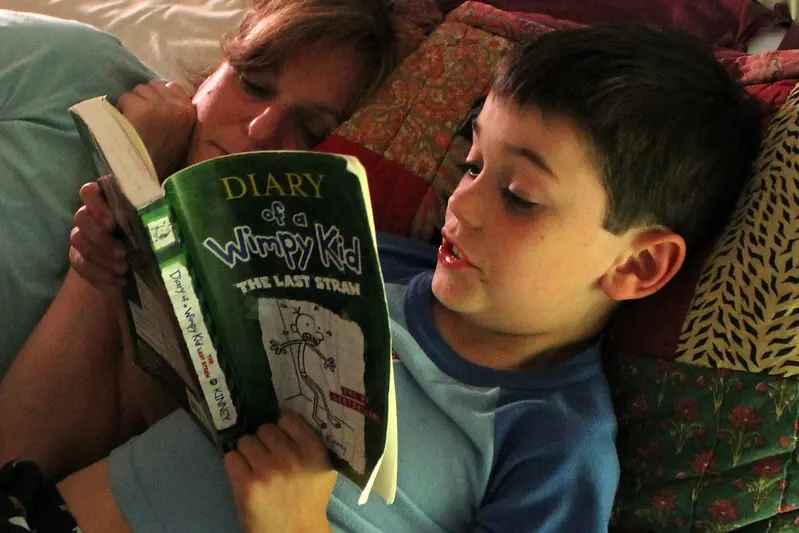
When, for instance, a child’s favorite book is “Diary of a Wimpy Kid” or “Big Nate,” he will likely continue, as he grows older, to desire stories that parallel the crudity of “Diary of a Wimpy Kid” – but he will no longer find those stories in the children’s section of the library. Perhaps the boy’s delight in crudity will be fulfilled innocently through his friends or his favorite podcasts. Perhaps it will be fulfilled through a YouTube obsession or a pornography addiction.
On the female side, a whole generation of girls grew up watching twaddle in the form of teenage television – “Gossip Girl” and “Pretty Little Liars” or, more recently, shows like “Riverdale” and “Outer Banks.” None of these shows are particularly pornographic; despite their unending romance plots, sex scenes are rare or tame. But they cultivate and feed the adolescent appetite for drama and flirtation. In so doing, they prepare young women to flock to media like “Bridgerton” and “Wuthering Heights,” in which sex is much more central. I count myself as one such young woman: after watching “Gossip Girl” in high school, I didn’t see a problem with watching more sexually-explicit television shows in my early college days.
But, mercifully, my main diet of media was not twaddle at any point in my life. I credit this to the robust and sometimes strict expectations of my parents and childhood Christian community. Because most of the stories I consumed were classics or their modern corollaries, I desired the depth and beauty of living books. I had already come to love what lasts. I eventually came to terms with what I had known all along: that most popular television shows were a waste of time and a distraction from the much better work of seeking truth and beauty where they might be found more fully.
Defenders of twaddle – whether of the latest hit kids’ show, beach read, or Marvel movie – often claim that their media of choice has positive benefits, like family time or mental relaxation. To some degree their claims are true: friends or family may bond over a trashy television show, and one beach read hardly has the power to alter a life. But a steady diet of twaddle, in an individual’s life or in that of a culture, does shape consumption and therefore souls. It is not the existence of twaddle but rather its ubiquity that sets our culture on a path towards porn and other dark ventures.
That single episode of “Hannah Montana” didn’t hurt me; it simply left me with an example of the allure of ephemeral twaddle. But I do wonder about my friends who watched and loved the show. What are they watching and delighting in now? When the glittery youthful world of Disney Channel is no longer satisfying, what will take its place, if not something with a much darker sheen?
—
This article was made possible by The Fred & Rheta Skelton Center for Cultural Renewal.
Image Credit: Flickr-woodleywonderworks, CC BY 2.0
1 comment
























1 Comment
Jay Don Reid
March 24, 2026, 7:10 pmEach day I read to my intellectually challenged daughter. She is a big fan of the old versions of light adventure books, e.g., Nancy Drew mysteries, Hardy Boys, and various other clean and morally positive works. Last year she heard about Louise Fitzhugh's "Harriet the Spy." I was unacquainted with the work, but I knew that it had been adapted for a children's film. We got the book from the library and began to read a chapter each day. Initially, I thought the book was a depiction of a "naughty" child who would eventually learn that her actions were inappropriate. Harriet's behaviour was eccentric, and it seemed to become worse with each chapter. Perhaps, I thought, this would serve to heighten the contrast with a redeeming denouement.
The crisis event of the story arrived. After Harriet is exposed as two-faced and completely self-absorbed, her erstwhile friends, deeply hurt by her betrayal, abandon her. Her cruel opinions about nearly everyone in her orbit, which come to light when she inadvertently leaves her journal and it is found by her schoolmates, reveal her perfidy. I wondered if this humiliation would result in a change of heart. It did not.
Yes, Harriet did regret her predicament, but not because she realized the evil of what she had done. Rather, she regretted having been exposed. She had to find a way to recapture her relationships. She confides in her former nanny, "Ole Golly," seeking a plan for social redemption. Her confessor tells her that the best way forward is simply to lie. Harriet need not be truly remorseful; she just needs to minimize the authenticity of her hurtful words, apologize to her friends, and pretend that her apologies are sincere. She embarks on this course and, to an extent, she gradually succeeds.
Thus, we have a story whose heroine is self-absorbed, callous, and deceitful. When caught she has no epiphany. Her heart is not broken for her own actions, and she is not ashamed. Her confidant advises her to compound evil with further evil . . . lies and insincerity. For Harriet this works. She does not become a better person, let alone a good person. One is left with the impression that Harriet will certainly be more cautious, but no less duplicitous.
I suspect that this not exactly in the realm of twaddle, but I believe it to be another example of works that lead our children away from honesty and kindness, substituting self-interest and a blurring of morality. Interesting? Perhaps — but lacking any promotion of sacrifice and heroism. Whereas twaddle damages the mind by filling it with shallow fluff, books such as Harriet the Spy take it one step further, casually glorifying unworthy motivations. This might be the "much darker sheen" that follows on the heels of "twaddle."
REPLY