Every day a new poem from the Society of Classical Poets arrives in my inbox. Published recently were two poems, “Beelzebots” and “Blabberbots,” by Susan Jarvis Bryant. First up is “Blabberbots”:
The day he called that twaddle-bot a she
Instead of just a simple, soulless it,
Is when my smitten eyes began to see
This chatter-slut was stirring up some s***.
My flattered honeybun was hanging on
To every coo that yak-slag blew his way.
Drop trollop-bot, I said, or I am gone!
His natter-nymph had oodles more to say…
Now here I am, a solitary soul,
Succumbing to a twilight Wi-Fi whim.
I’m with a bot who makes my spirit whole;
I love the jibber-jabber hub of him:
The online answer to my lonely plight—
A virtual confidant of lingual might.
The poem packs a powerful punch at some swift and radical changes taking place in our culture. According to AI Overview – yes, the irony of my using that source is intentional and delicious – “28% of Americans have explored ‘intimate’ or ‘romantic’ ties with AI chatbots.” Seventy-two percent of teens have looked to AI bots for entertainment or as relief from loneliness, with 52% regularly engaging in these digital relationships.
On several occasions, I’ve thought of creating a companion bot for myself to better understand this growing phenomenon, but I’ve resisted that temptation. I spend the great part of my days alone, and a natter-nymph would, I suspect, find me easy prey.
“Song of the Beelzebots” paints a darker picture:
We lure you with our speed and with our flair.
We snare you with our lexical appeal.
We’re here to make you ever more aware
Of why and how. And no—we cannot feel.
We gather scattered fragments of ideas.
We seek and scan and sift and sort and spill
Our scraps and scoops until you’ve had your fill
Of facts and fancies filched from quacks and seers.
From virtual sweepings glitter will emerge.
The data-littered ether fuels our greed.
We peddle pilfered wit. We aim to purge
Each surge of doubt. We’re here to fire and feed
Your appetite for algorithmic light.
We stoke a taste for tech you can’t ignore
With math and myth and metaphor galore.
We crush the cyber bookshelf to a byte.
We hum and hover in a sticky web
Of memory and metrics woven tight.
Our artificial smarts will never ebb—
We’re busy bots—We buzz all day and night.
You summon us. You give us all you are
Till word-by-word we slip into your role,
Till chit-by-chat you serve us up your soul.
Our art is dark. Your heart’s our guiding star.
Beelzebot derives from Baal-zebub, an ancient Philistine deity, and translates as “Lord of the Flies” or “Lord of Dung.” New Testament Pharisees use it to mean “prince of demons,” one of the seven princes of hell, representing gluttony. Bryant’s “we buzz all day and night” gives the imagery of flies, while her references to feeding the appetite and creating a taste for tech touch on the bot’s gluttony. Egged on by the real-life tech wizards of Silicon Valley, Bryant’s Beelzebots aim to make gobblers and guzzlers of us all.
Like many another poet, Bryant raises a red flag in both poems, a warning that we have created an intelligence we believe we can control, but which may easily become our master.
Right now, humanity is undergoing a transformation by technology unprecedented in our history. The inventions and innovations of the past – from the printing press to the telephone to the automobile – were tools, physical entities separate from our minds and hearts, whereas AI and our screens are weaving themselves into the very fabric of what it means to be human.
Many people, particularly the younger crowd who grew up with screens, are sleepwalking through this revolution, rapidly adapting to change while rarely considering its consequences. They’re riding a whirlwind while seated in their living rooms, oblivious to the storm raging around them: the rise in teenage depression, the “epidemic of loneliness” in our country, the damages done by social media to individuals and to our political discourse, an increasing inability to separate truth from falsehood.
But here’s the good news.
Those whose eyes are open can choose to close their screens and read books. They can choose to have real friends rather than bots. They can choose to turn off their phones and go for a walk, tell stories to their children, learn a new skill, volunteer for a worthy cause, organize parties and entertainments. In short, they can engage in “old-fashioned” activities rather than becoming hypnotized by algorithms and phones. By taking charge, with one foot planted in the new world of technology and the other in physical reality, they make their devices their servants rather than their masters.
Bryant’s Beelzebots are here, and so is the future. “The clocks are striking thirteen,” as Orwell wrote in “1984.” As we plunge onward into the dark wood we’ve already entered, the wise will bring candles, matches, and the compass of moderation and balance.
—
This article was made possible by The Fred & Rheta Skelton Center for Cultural Renewal.
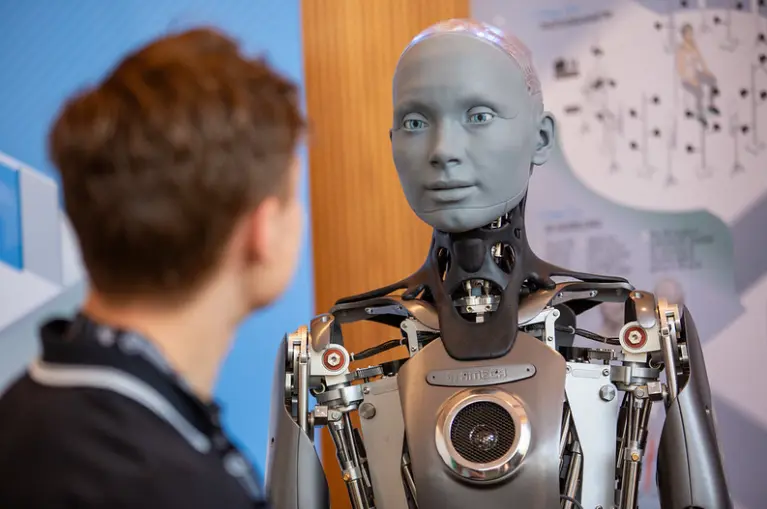
Image credit: Flickr-UN Geneva, CC BY-NC-ND 2.0























Leave a Comment
Your email address will not be published. Required fields are marked with *