
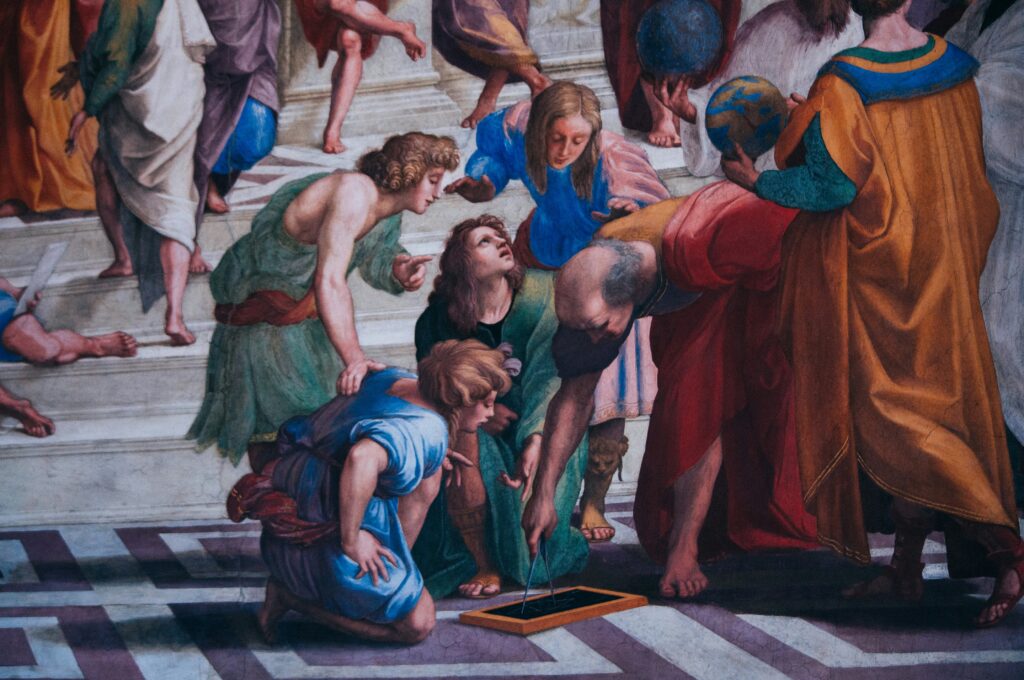
It is still an unfortunate assumption that science has usurped philosophy as a discipline, leaving the latter with no real consequence in the world. Even those who pay some respect to philosophy often consider it as knowledge existing in the purely subjective realm, while physical sciences (biology, chemistry, etc.) are what make real changes in the world.
This assumption, ironically, relies on a certain philosophy that presents a false dilemma between two legitimate fields of knowledge. It assumes a competitive relationship between science and philosophy whereby emphasizing one or the other must diminish. This philosophical statement also illustrates the very need for philosophy for anyone to make any sort of conclusion about reality at all, including a conclusion about the reality of science.
‘The First Scientist’
Aristotle, considered by many as the father of science, recorded these observations and conclusions. He also provided principles to guide scientists in their own work, which continue resonating today even after his observations and conclusions have been surpassed.
One of these lasting principles is the recognition of the four causes, the four different ways one can answer the question of “why” when empirically observing phenomena. The four causes include the material, the formal, the efficient, and the final, and continue to shape scientific thinking even in modern contexts, as science has always been built on the act of observation and drawing conclusions from those observations.
Material
The material cause consists of the stuff that makes up an object. This is often the easiest to determine through simple observation, and as technology has progressed, scientists have discovered deeper and deeper insights into the material cause.
Formal
The formal cause is defined as the shape of an object. Simple or complex, general or specific, this shape must be consistent and include essential elements of the object in question. It also includes a definition of the object. A classic, humorous, example of this includes the Platonic definition of man as a “featherless biped.” While this oversimplified definition was mocked by Diogenes the Cynic, it shows the importance of precision in definitions, highlighting the presence of the formal cause.
Efficient
The efficient cause is the agent that brings the material and formal cause together. While many think “agent” means it must be personal (i.e. God), it need not be. This is true even if someone doesn’t believe in God. For example, one could point to the process of evolution as an efficient cause for the development of a new species, citing evolution as the process that brought together the materials, the genes from generations of parents, and the classifying features of the new species together.
Final
The final cause is the purpose toward which the previous three causes are directed. The final cause is built into the object by the efficient cause using the materials to form it. Though this cause comes from observation, it is slightly more controversial because it implies motivation. While the language might imply going beyond pure observation, the final cause is still based on seeing how an object typically, near-universally, behaves.
This final cause is where the term “teleology” derives. Teleology is the study of final causes in objects, and is an essential element of the scientific method. Part of the scientific method includes making a hypothesis of the experiment. This hypothesis is based on expectations of the variables of the experiment. One can only have expectations of behaviors if one presumes a teleological outlook of nature. For example, one expects a flower to grow toward light because that is what flowers are made to do.
Final cause also has a similar effect on the conclusion one draws from the scientific method. When one conducts an experiment that produces a conclusive result, one can draw from this result that under the circumstances of the experiment the object is supposed to act a certain way. Even if one does not use the language of final cause (“the purpose of a flower to take in nutrients, so it moves toward light”), the conclusion that a flower always does this under normal circumstances implies these assumptions.
Every Other Cause Is Ordered Toward the Final
Though it is less conventional to use final cause language in science compared to recognizing the material, formal or efficient causes, because of the inherent connection between the four causes the final cause must still be considered in science today. The chemical makeup of a plant (material cause), the shape of the leaves or length of the roots (formal), and the parents of the plant (efficient), all work together so that flower can collect nutrients (final). In rejecting the final cause, one is then disconnecting that which united the other three, negatively impacting the work of science overall.
As science continues to progress technologically, it is important that it maintains its philosophical roots planted by great minds such as Aristotle. This way, science will continue to be strengthened by that firm foundation in order to confidently move forward to its own final cause of finding truth in the universe.
—
This article was made possible by The Fred & Rheta Skelton Center for Cultural Renewal.
Image credit: Unsplash























Leave a Comment
Your email address will not be published. Required fields are marked with *