
What is the definition of a “good father”?
Some might say that a good father is one who provides well for his family. Others would suggest that a good father is one who shows up for both the big and little events in life. Still others might define a good father as a man who protects those under his care.
All those answers are true. But there’s another component to good fathering that many of us may overlook: warmth.
Author and theologian Dr. Anthony Bradley recently addressed this issue on his Substack, taking a look at a variety of studies on parenting and its outcomes. His research led him to conclude that parents who show love through physical affection, verbal affirmation, and a general attitude of acceptance and availability will likely raise children who are psychologically well-adjusted, better learners, and stronger in character. This is especially the case with fathers, for “paternal acceptance had a stronger relationship with psychological adjustment than maternal acceptance,” Bradley reported.
Even more interesting is Bradley’s discovery that “the most predictive factor in a child’s faith persistence into [an] adult was having a father characterized by warmth.” That’s an interesting tidbit, for although faith and religious practice have stabilized in recent years, they still have experienced quite a decline, with the number of “religious nones” in the U.S. rising from 16% to 28% between 2007 and 2023.
Personal experience underscores this fact. In recent years, I’ve found myself discussing my upbringing with other friends. On one occasion, a couple friends and I pondered why we had persisted in our faith into adulthood, while others raised alongside us drifted away or rejected it outright. We concluded that the common denominator among those who remained faithful was the possession of parents who were open and honest with their children, unafraid to confess their faults or admit when they made mistakes. In other words, they had a warm, humble, open relationship with their children.
Another time, a friend and I were discussing the importance of fathers when I mentioned how grateful I was for a father that always took my faults and foibles in a measured, calm manner. As a result, I was much more open and honest with my father when I was in trouble, for the fear of an angry response was not a concern. Again, the warmth of a father made all the difference.
A more famous example of this is Christopher Tolkien, the son of J. R. R. Tolkien. The letters between the two reportedly show that “they found mutual encouragement in the Christian faith.” The letters also show that the elder Tolkien was not averse to expressing warmth and affection to his son. “And you were so special a gift to me, in a time of sorrow and mental suffering, and your love, opening at once almost as soon as you were born, foretold to me, as it were in spoken words, that I am consoled ever by the certainty that there is no end to this,” he wrote in one 1944 letter. The younger Tolkien is famously known for advancing and continuing his father’s work, and the respect and honor of this gesture indicates that there was indeed a warm relationship between this father and son.
Some may look at these warm relationships between fathers and their children and express skepticism. This is particularly true in the rising popularity of the manosphere, which suggests that men are too soft and must revive their rough-and-tough ways in order to push back against the effeminacy that has prevailed in our society in recent years.
It’s true that we desperately need more masculinity in our society, strong men to stand up and be the protective leaders who fight for their families and communities. But as is often the case, when we push back against something, we can often unintentionally cause the pendulum to swing too far the other way.
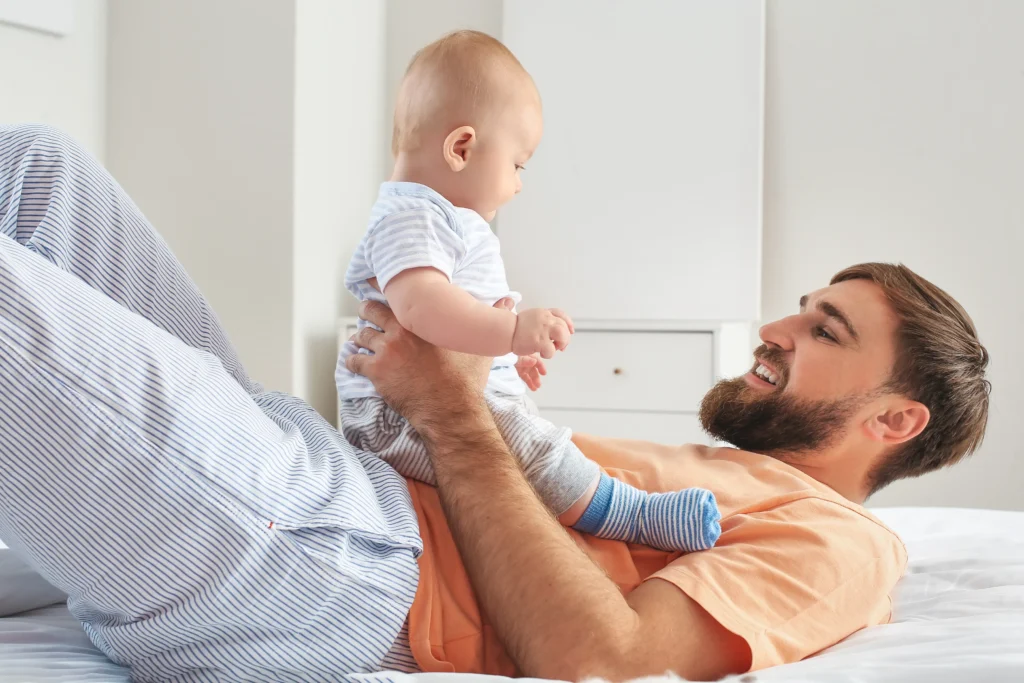
That is why we must remind fathers that they walk a difficult line. Men must put on that tough, masculine strength in the world to protect and lead their families, but they also need to put on warm and gentle affection inside the home when dealing with their wives and children. Such a feat is not impossible, for I’ve seen and interacted with men who seem tough in the real world, but as soon as their children come around, they melt and become the gentlest, most loving fathers around.
That kind of balanced masculinity should be our goal for the men of America, for as Bradley’s research indicates, adopting it may be the difference between families continuing in faith and character, or shipwrecking completely.
—
This article was made possible by The Fred & Rheta Skelton Center for Cultural Renewal.
Image credit: NegativeSpace

























Leave a Comment
Your email address will not be published. Required fields are marked with *