
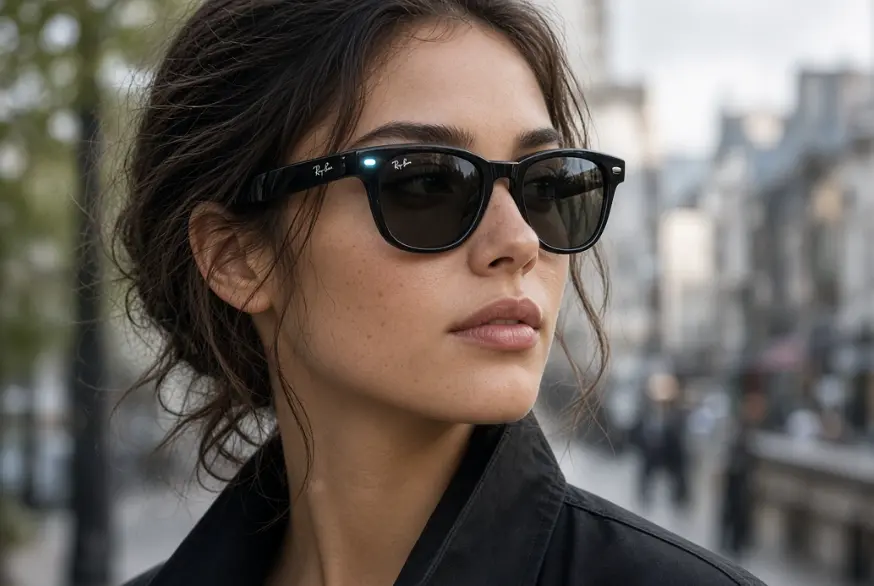
It’s devastating enough that the safety protocols surrounding AI use by minors have been lagging. But now there’s a new piece of technological slop that has forced itself into the classroom. Enter Meta’s AI smart glasses. It turns out that there’s something to Murphy’s law.
The glasses can record video and audio at the tap of a temple. If a bystander doesn’t want to be recorded, they’ll have to be vigilant to look out for a little white LED that comes to life on the glasses. Seven million people bought a pair just last year, and this month, a Futurism investigation found out the alarming truth about what happens when this kind of technology is given to teens with a TikTok account and no adult supervision.
Reporter Maggie Harrison Dupré looked at dozens of videos captured at middle and high schools. Nearly all the footage was recorded by boys and aimed at girls. In one clip, a boy walks alongside a classmate as she enters the school, heckling her, insisting that she give him her Reddit handle. Even after she says no and tries to walk away, he keeps following her. In another clip, a girl approaches a boy with a metal stool after he refuses to stop filming her. Eventually, an adult steps in before the situation escalates.
Andy Liddell from the EdTech Law Center shared with Futurism that using Meta’s AI smart glasses in the classroom is “a terrible idea.” He noted that both teachers and students have an expectation of privacy in school that they don’t expect to have on the public sidewalk.
One trick shows up across several video clips. A boy will film himself asking a student, often younger, for help, before approaching a girl, claiming that one of his friends wants her number. This whole act is put on for the purpose of posting it to social media later. In response to concerns, school districts in Florida, California, and Nevada have already banned the devices completely. The assumption is that more states will follow suit this fall.
This isn’t the only issue Meta has encountered concerning privacy for teenagers recently. Something similar happened that resulted in Meta getting sued back in March, after a TechCrunch report broke down how subcontracted workers in Kenya were looking at the footage pulled from adult customers’ glasses. Some of this footage included nudity, sexual intimacy, and people using the bathroom, even though Meta’s ads claim that owners stay “in control” of their content. This particular case is still working its way through the courts.
Meta is currently on trial in Oakland, facing up to $1.4 trillion in penalties. The lawsuit argues that the company deliberately built Facebook and Instagram to get children addicted. Four states are attached to this case: California, Colorado, Kentucky, and New Jersey.
But this isn’t the first time Zuckerberg has had to answer for what his platforms do to children. In 2024, he stood up during a Senate hearing, turned to face the parents of children who’d been harmed on his platforms, and said, “I’m sorry for everything you’ve all gone through.” Unfortunately, that apology didn’t lead to updated policy changes big enough to prevent the most recent lawsuits.
I’m not suggesting that cameras in schools should be banned. Perhaps they should. I’m also not suggesting that Meta deliberately set out to build an elaborate bullying machine. But again, perhaps they did. Futurism’s report captured what teenagers have always done with new technology – use it with poor judgment.
I suggest that Meta’s track record on privacy promises doesn’t get the benefit of the doubt anymore. Not from regulators. Not from school boards. And certainly not from parents. Before this kind of technology can be used wisely, we must ask ourselves, as the Roman poet Juvenal did in his “Satires,” “Quis custodiet ipsos custodes?” – that is, “Who will watch the watchmen?”
—
This article was made possible by The Fred & Rheta Skelton Center for Cultural Renewal, a project of 1819 News.
Image credit: Grok
























Leave a Comment
Your email address will not be published. Required fields are marked with *