
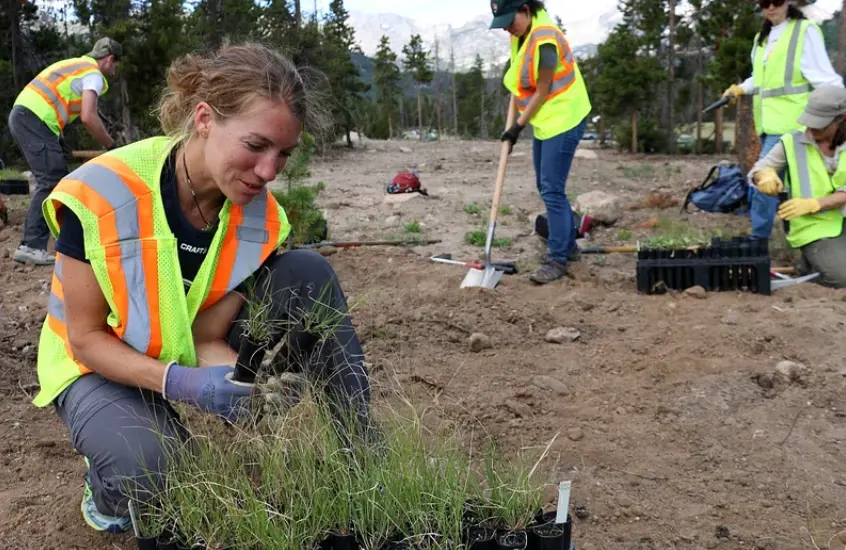
While at home over Christmas break this past December, I attended a volunteer opportunity as a chaperone for my church youth group. We worked a shift at Feed My Starving Children (FMSC), a ministry that ships hand-packed meals to distribution partners worldwide. A mix of upbeat pop tunes and Christian hits blared as we washed hands and filed into the packing room. It was filled with metal tables set up to form the U-shaped packing stations, each manned by about 20 to 30 people. Our group filled two of the five stations that night, helping pack 108 boxes in an hour and a half, which translated to over 23,000 meals for children overseas.
The experience reminded me of the huge impact that volunteering can have. Serving at FMSC that night didn’t require that much of us – just a couple hours out of the week – but for the children who received the meals we packed, it could make the difference between life and death. I was energized, returning home eager to do it again and find other ways to volunteer. But once I returned to the fast pace of college life, my volunteer desire faded.
That’s not surprising, for in a world where human connection and interaction increasingly take place on a screen, in-person volunteering can seem like a needless drain on time and resources. Only 28% of Americans report spending time formally volunteering with some kind of nonprofit organization.
Gen Z’s volunteer numbers are even worse. In a 2023 survey, only 36.4% of Gen Zs reported participation in informal volunteer work, compared to 52.2% of millennials and over 60% of both Gen Xers and boomers. Formal volunteer numbers are even lower: 24.5% of Gen Zs volunteer, compared to 29.4% of millennials and 32.3% of Gen Xers. The age of the typical nonprofit volunteer falls in the mid-to-late 40s, and religious nonprofits skew even older, with a median age of 60.
The type of volunteer work that many people are looking for is also changing. Hybrid or virtual volunteer opportunities are growing, with nearly 20% of volunteers participating partially or completely online. And while the total number of Americans who participated in formal volunteering has grown, the average number of hours per volunteer has significantly declined. The reason? Episodic volunteering is on the rise as regular, long-term commitments to volunteer work become less popular. Episodic volunteering opportunities are short-term and often one-time, asking volunteers to work for special events or during certain seasons. So-called “informal volunteering,” which simply means helping one’s neighbors, remains far more popular than formal volunteering.
Unfortunately, the decline in long-term and in-person volunteer participation shows that Americans are becoming increasingly unwilling to donate their time to community service. The formal vs. informal volunteering split seems to indicate that people are much less willing to go out of their way to help others, preferring to simply accept opportunities to serve when they appear rather than taking the initiative to find a regular volunteer opportunity.
During his 1831 visit to America, French political theorist Alexis de Tocqueville observed that Americans excelled at what he called “the art of association.” This was caused in large part by Britain’s decades-long policy of salutary neglect, which forced the American colonists to rely on their own resources to bring about needed civil projects. Tocqueville believed that the practice of association trained people in the habit of self-government and prevented them from relying too heavily on government ministrations, thus acting as a foundation of freedom.
Volunteering is just one manifestation of the art of association, but it’s one that is widely accessible and quite valuable. It helps build relationships in the real world and gives people a sense of purpose and belonging. It reminds them that they can look to friends, neighbors, and fellow community members for help when they need it, rather than relying on government programs and handouts. For Christians, it’s an opportunity to show the love of Christ to the needy in our communities and even around the world. It reminds us that we’re not meant to inhabit an individualistic little universe of our own making, but to live in community with others.
Today, as many communities are torn by political polarization and hyperbolic rhetoric, volunteering might be more important than ever before. It’s a great opportunity to escape our online echo chambers and interact with other people face to face in a meaningful way.
So, check out volunteer opportunities in your area. Start small – maybe an hour or two a week – and don’t give up on it. If you have teens or younger kids, encourage them to join you. Gen Z and the generations below it desperately need human interaction and a sense of purpose and belonging. Volunteering can help begin to fill that need.
—
This article was made possible by The Fred & Rheta Skelton Center for Cultural Renewal.
Image credit: Rawpixel