
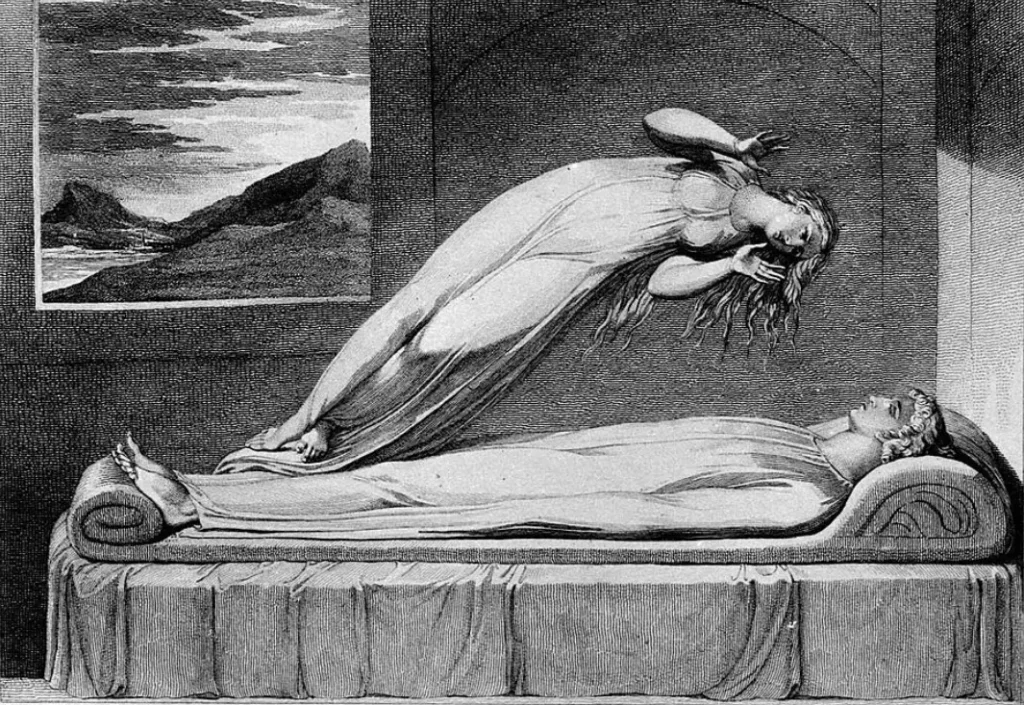
“What happens to me after I die?” is one of the most common questions in human history.
While virtually every religion in human history provides answers to this question, they are often specific to that culture and faith. However, philosophy seeks to answer the question using principles accessible to every human by virtue of his ability to reason. This philosophical answer need not conflict with the religious answer. In fact, religions that integrate philosophical demonstrations often provide the most satisfying answers.
What Is the Soul?
“Soul” comes from the Latin word anima, meaning “principle of life.” Therefore, the soul is that which gives life. Life, for its part, is distinguished primarily by a specific type of movement.
Humans have recognized movement as the best indicator of life even before we were capable of articulating the idea. This influenced the formation of the word, anima, for soul. For example, giving life to a still picture “animates” it. Yet we also know that we can move non-living things and create things that move automatically, but this does not make them alive.
A further distinction between the extrinsic movement of non-living things and the intrinsic movement of living things is called “transeunt causation” and “immanent causation” respectively. There is nothing inside a ball or engine that moves it. They must be acted upon by something outside of them. However, a living substance has movement built into it and integrates things outside of it to keep moving.
The ‘Form’ of the Body
Forms, according to Plato, are the immaterial realities from which the physical world is derived. For example, we recognize a chair because there is the form of a “chair-ness” that transcends every individual instantiation of a chair. Without the form there could be no way to make the thing that everyone recognizes as a chair. This reality applies to every living thing as well as the thing that gives life to those things: souls.
Aristotle, however, believes in a formal cause of everything that exists, but does not believe there is a plane of existence for forms separate from everything else. Rather, he sees the form as present within a species. For example, most can recognize the traits that make something a dog even though there are numerous varieties of breeds, sizes, and colors of dogs in existence. However, there is no “form” of all dogs that exists on some abstract plane that somehow includes every different feature of every type of dog, while still retaining some appearance of a dog. This would contradict itself.
This is how Aristotle describes the soul. He calls it the form of the body because it is what gives definition to that substance. This does not primarily apply to your physical body, which changes drastically throughout life, but to your identity.
Three Types of Souls
We share life with plants and animals, but each of these lives look different. Aristotle reflects on these differences and draws from them three types of souls found in living things.
There are three powers of the vegetative soul: nutrition, movement, and generation. Because the soul is the form of the body, the body is going to follow the soul. If the soul is capable of nutrition, then the body follows its form. If the soul produces movement, even the simple movement of growing upward toward nutrition, then the body will follow. If the soul, the principle of life, generates life, then the body will have this capacity.
The order builds upon itself so the next type of soul, the sensitive, includes the three previous powers as well as the powers of sensation and consciousness.
Finally, the third type of soul, the rational, includes the previous powers, as well as the power of the intellect, to reason through abstract concepts, and the power of the will, to choose from the information provided by the intellect. These last two powers, intellect and will, point toward the soul’s continued existence after death.
Intellect is Not Bound to the Body
While the soul, by definition, is that which gives life, this does not guarantee that it continues after the death of the body. If the soul is tied to the body, then maybe the soul of that person (since every individual person’s soul would be different just like an individual person’s body is different) dies with the body when the body dies. This is what Aristotle and Thomas Aquinas believed to be the case with any individual plant and animal. The difference with humans is the rational soul, which contains the power of the intellect.
Intellect does not just mean it can think faster or longer than an animal brain can, it means that it can comprehend abstract ideas. It can picture a non-physical thing like justice. While an animal can sense a chair or a dog, a human can define the form of chair-ness or dog-ness. These abstract concepts, because they are not physical, are not tied to the physical body in the same way as sensation.
For Aquinas and Aristotle, the individual rational soul preceded the body, because it is its form, so it does not rely on the body for its existence. Therefore, when the body dies, the soul need not.
This does not answer any religious question of how the soul experiences existence after the body dies or where an individual soul “goes” after the body dies, but any religious question, because it requires the existence of a soul, would have to account for these truths about their nature.
—
This article was made possible by The Fred & Rheta Skelton Center for Cultural Renewal.
Image credit: The soul leaving the body (Luigi Schiavonetti, Public Domain)






















Leave a Comment
Your email address will not be published. Required fields are marked with *