
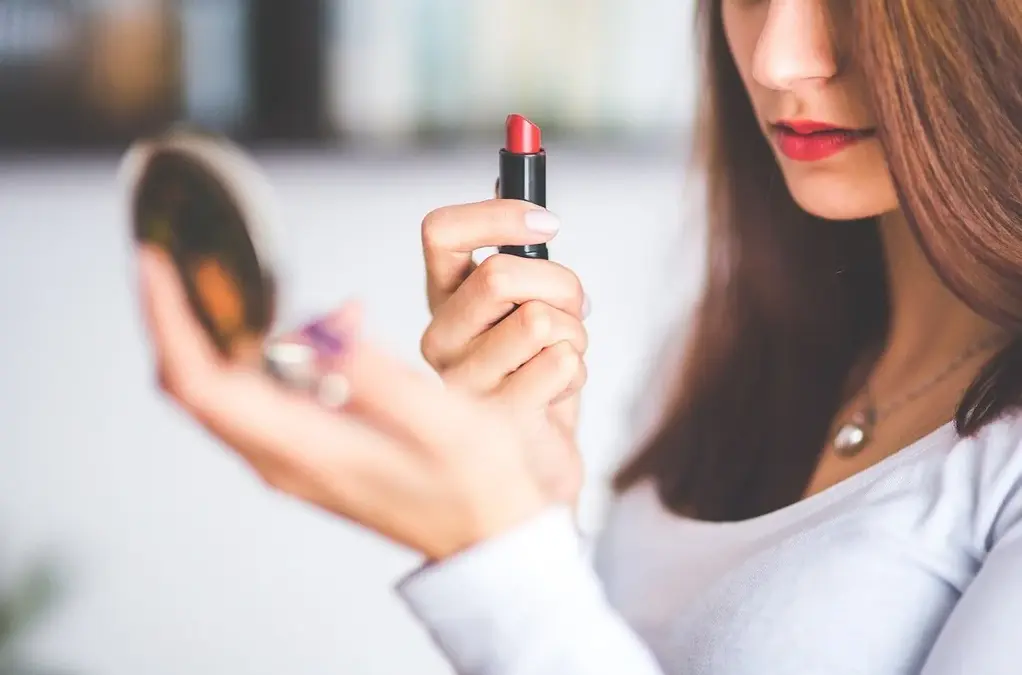
If you’ve ever seen a little girl with a toy makeup kit, you’ve likely seen something akin to a cat who got in a fight and lost – badly. The compilation of green eyeshadow on one eye, blue on the other, hot pink blush, and reddish-brown lipstick may look like a patchwork quilt to adults, but to the little girl, her face paint makes her look beautiful.
We may well chuckle at the garish picture these makeup novices present with their unnatural coverups. Yet even while we laugh, it seems that makeup trends for adults do the same thing – perhaps not in the mismatch of green and blue eyeshadow, but rather in the heavy covering of anything natural. And in such a situation, we glimpse an interesting view of society’s soul.
Discussion about beauty on social media is nothing new – after all, makeup tutorials, beauty tips, and “get ready with me” videos are a dime a dozen among the influencer class who want as many clicks as possible. These videos often present miraculous transformations, sometimes leaving the viewer wondering if the person the video originally began filming is still there by the time the contoured, Kardashian-esque makeup face is finished.
But lately, I’ve noticed a shift in the wind. While there are still plenty of glamorous, heavily made-up examples out there, it seems like more people are beginning to question whether the natural, less-heavily-made-up look is more desirable.
Consider this example posted on X, which compared actresses Sydney Sweeney and Sabrina Carpenter. Sweeney still wore makeup, but in a way which made her look like a normal woman, while Carpenter, according to some, looked like a porcelain doll, unnatural and unrelatable. Given the comments, it seemed that men and women alike thought that Sweeney’s natural look made her the more attractive of the two.
Other discussion on this issue noted that a more heavily made-up look is reminiscent of today’s drag queens, the men who, in trying to pass for women, cover themselves in makeup in a clownish fashion, making a mockery of both them and femininity in general.
While contemplating such discussion, I came upon an intriguing quote from philosopher Roger Scruton’s book “Beauty: A Very Short Introduction.” Although used in relation to the natural beauty of landscape and design, Scruton’s thoughts – based on those of fellow philosopher Immanuel Kant – seem to apply well in the case of natural human beauty as well:
Kant also believed that natural beauty is a ‘symbol’ of morality, and suggested that people who take a real interest in natural beauty thereby show that they possess the germ of a morally good disposition—of a ‘good will’. His argument for this is elusive: but it is an opinion that he shared with other eighteenth-century writers, including Samuel Johnson and Jean-Jacques Rousseau. And it is an opinion to which we are instinctively drawn, hard though it is to mount an a priori argument in its favour.
As Scruton admits, such an argument is hard to prove … yet it does provide interesting food for reflection.
For starters, do the recent trends toward heavy makeup – both for women and those who want to appear as women – indicate that we as a society are devoid of moral goodness? Perhaps we sense this void deep down and seek to cover it up, putting the lipstick on the proverbial pig to make ourselves feel and look like the polished and presentable image of goodness we want to be.
On the other hand, could the rising interest and trend toward natural beauty, as seen in the favorability toward Sweeney’s more down-to-earth looks, indicate that there is an interest in returning to that moral goodness? And when we return to it, will its effects on our hearts overflow onto a countenance that doesn’t need the layers of makeup in order to be beautiful?
The old adage proclaims that you can’t judge a book by its cover … and yet, what’s in the heart is often evidenced by what’s on the outside. Coupling that thought with the above from philosophers of old, we should ask ourselves what our own appearances and those of whom we seek to emulate say about what’s on the inside – not only on an individual level, but on a national one as well.
—
This article was made possible by The Fred & Rheta Skelton Center for Cultural Renewal.
Image credit: Picryl

























Leave a Comment
Your email address will not be published. Required fields are marked with *