
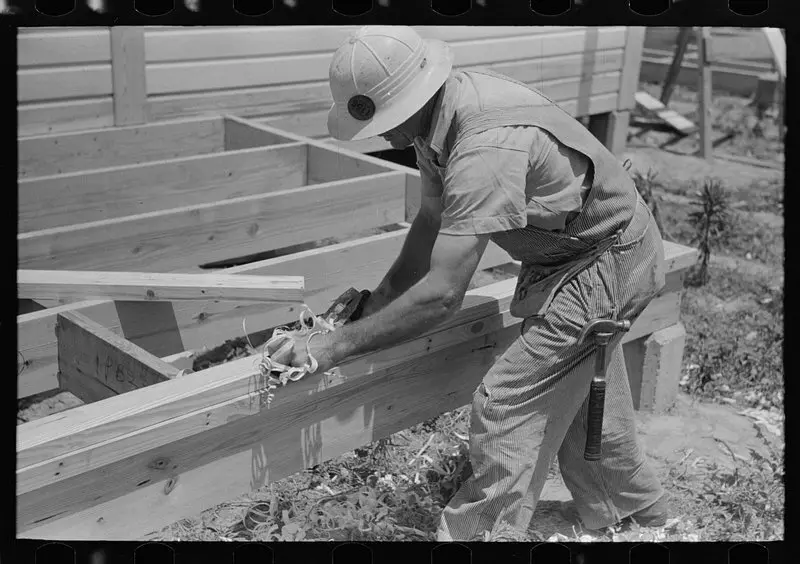
I am not a carpenter, and my hands are more comfortable on a keyboard than a skill saw. But I took it upon myself to try to build something this summer, namely, a coat closet and built-in cabinets with a window seat around the window in our entryway, where coats and boots and other outdoor gear have long had a way of piling up in frowsy, unkempt piles.
I wanted to bring some order to the room, and, I suppose, I wanted to prove to myself that I could build something like that. Not being very handy, I’ve always envied the man who knows how to fix machines and plumbing without consulting YouTube, and who can build anything you might need with just a few scraps of wood and some twine. Such men move with ease through the physical world, with sure, steady motions and strong, rough hands that know the heft and heave of things.
My closet and cabinets turned out alright, not perfect, not professional, but still tolerably good-looking and useful, and certainly a huge improvement to the junkyard of coats and boots it replaced. Through the endeavor, I came to understand the satisfaction that grows from taking ownership of your immediate environment – taking it in hand, quite literally – and making it more orderly, more beautiful, more useful.
I want to use this as a kind of metaphor because I think cultural restoration, in most cases, looks something like this. It starts in small, quiet efforts to make some place you love just a little better. National programs, national politics, and so on have their importance, but most of us will have little effect on the national scale. However, all of us have the capacity to affect, in a constructive, healthy way, our immediate environment – our home, our place of work, our neighborhood.
Literature professor John Senior perhaps said it best when he noted, “Restorations never start at the collapsing top but always in the dull low places of simple hearts, not in the roaring of the wind but in the whistling of a gentle air.”
And when we begin to think in this way, when we begin taking responsibility for that under our influence, working in the “dull low places,” we can achieve a greater sense of agency and even peace. I can do little to correct corruption in Washington, and so focusing my attention on it brings frustration. But I may be able to fix the corruption on the local school board, and that is no mean task with no small cataract of effects for the community and culture around me.
Perhaps those of us concerned by the direction of our society ought to follow the philosophy of self-help gurus: don’t aim to fix everything all at once, just get 1% better every day. The results will compound over time.
Of course, some people are called to fix Washington (and I wish they’d get on with it!). Some people make a worldwide impact. But most of us do not. And there’s risk in setting our scopes on distant national or international problems – the fear-inducing grist of the meat grinder of social media and 24/7 news feeds – while neglecting to make the small but meaningful improvements in one’s own home, one’s own community, that do in fact lie within the individual’s power.
Maybe that’s the best we can hope for, most of us, and maybe that’s more than enough – to improve our little corner of the world, with something beautiful and useful, something that costs us a little sweat and pain. A labor of love – like a coat closet – that will make life better for those who occupy our houses after us.
And maybe if each man and woman took some such matter in hand, and resolved to improve, as best he or she could, that one little corner, to fix at least one broken thing, to heal at least one wound – well, then that would be a lot of fixing and a lot of healing in this world.
—
This article was made possible by The Fred & Rheta Skelton Center for Cultural Renewal, a project of 1819 News.
Image credit: Rawpixel
























Leave a Comment
Your email address will not be published. Required fields are marked with *