
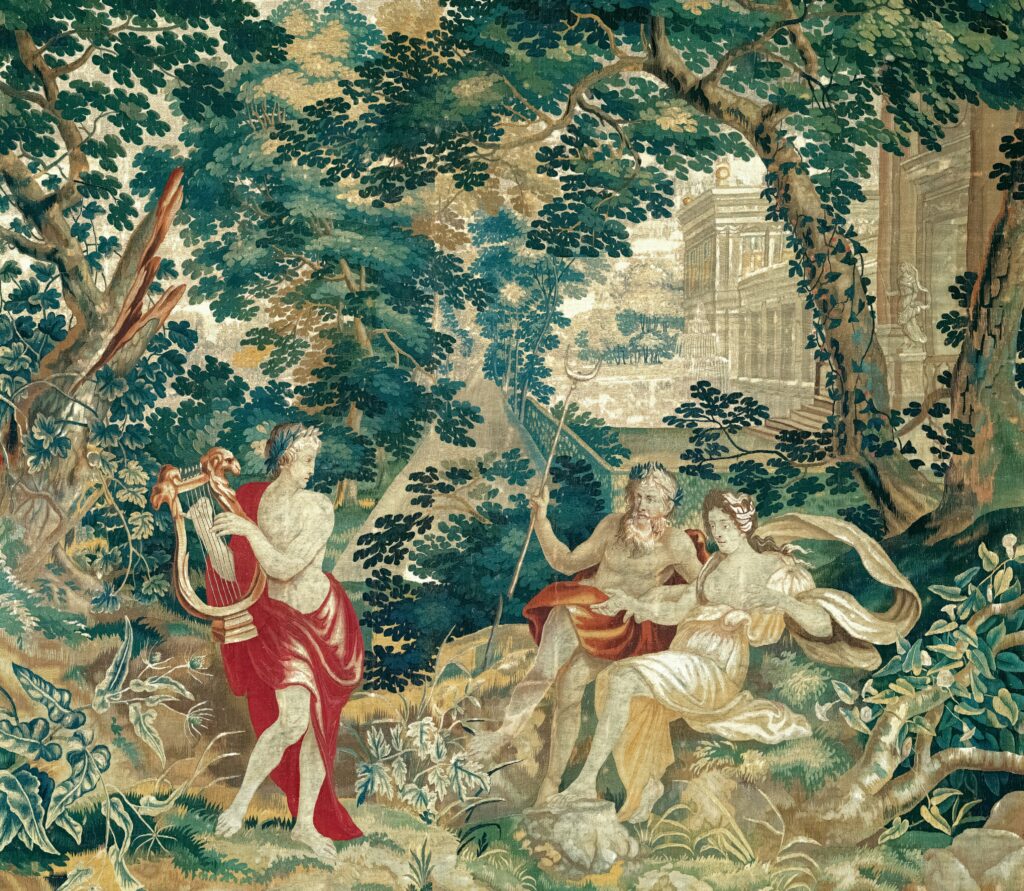
“One ought, every day at least, to … read a good poem.…” – Goethe
Interest in the epics and poetry of antiquity is seeing a surprising revival in the 21st century. Part I of the retelling of the Arthurian series by Malcolm Guite, “Galahad and the Grail,” enjoyed wide success last spring and has the literary world hotly anticipating Part II, “The Coming of Arthur,” this November.
One of the biggest movies of the past year, “The Odyssey,” provided a fresh, albeit somewhat controversial, look on one of Western civilization’s oldest and most formative tales. Its success, along with director Christopher Nolan’s ability to tell epic stories, inspired some on social media to call for Nolan to direct another epic poem, “Inferno” by Dante Alighieri. This tale, set in the hell of the damned, shows the spiritual realities of a soul immersed in sin.
Finally, the Tony Award-winning Broadway musical, “Hadestown,” tells the tale of Orpheus and Eurydice. This ancient story itself was often sung to audiences as it was passed down thousands of years ago. The play has enjoyed renewed interest in its own movie theatrical run and subsequent release on streaming.
Each of these stories is truly inspiring. Even the “Inferno,” which recounts Dante’s travel through the depths of hell, is part of a larger journey that ends in the beatific presence of God.
However, there is a deeper resonance in the way these stories are told that adds to their beauty; namely, poetry. Even when these stories end tragically, like the fates of Orpheus and Eurydice in “Hadestown” or the silly modern example of “Casey at the Bat,” who strikes out and loses the game for his team, one is left inspired by their example. Epic poems, because they point to something beyond this world, are meant to show how the world could be.
Everything about the epic poem must be transcendent to the reader. The hero must be godlike or sanctioned by God or the gods. Gilgamesh, according to his “Epic,” had divine ancestry. Orpheus was the son of Calliope, one of the nine Muses. Odysseus, while not a god or demigod, was trained by the goddess of wisdom, Athena, and receives divine help from the god Hermes in his voyage back to Ithaca. Each of these characters is guided by wisdom and sacred laws, thereby living beyond the purely natural world.
The hero’s quest must be superhuman and, often, their quest takes them to places beyond the natural world like the bottom of the sea or the gates to the underworld. Gilgamesh swims to the bottom of the ocean to retrieve an immortality-bestowing plant. Aeneas escapes the burning city of Troy in order to establish a new city for its survivors, a city that would become the center of the great Roman Empire. Dante travels to the bottom of Hell. Numerous times, the Saracen army is described as overwhelming and formidable against Count Roland in “The Song of Roland.” The monsters and forces keeping Odysseus from reaching his home are beyond the strength and wits of any normal human. Beowulf in his eponymous epic poem must kill three separate monsters until his own death. Orpheus, not to be outdone, tries to overturn the laws of death itself.
These works of classic literature are the cure to the stunted sense of wonder and awe that the modern world undermines. Because every aspect of these stories points beyond the merely natural world to the transcendent, spiritual realms, they draw the hearer and reader into these worlds.
It should come as no surprise that the most popular modern examples that incite this same sense of wonder – the “Chronicles of Narnia” by C. S. Lewis, “The Lord of the Rings” by J. R. R. Tolkien, and even “Harry Potter” by J. K. Rowling – all cite these works of epic poetry as their inspiration. Think of how similar “The Voyage of the Dawn Treader” is to the “Odyssey.” It is no accident that the horn of Count Roland, and his fate, resembles that of beloved Boromir. There are countless underworld journeys for Harry and his friends throughout the series.
Humanity, by its nature, is made to both recognize and participate in beauty. The epic poems, especially the great ones that have stood the test of time, but even the recent ones that we are still creating today, all participate on this scale and pull us toward something beyond ourselves.
—
This article was made possible by The Fred & Rheta Skelton Center for Cultural Renewal.
Image credit: Unsplash






















Leave a Comment
Your email address will not be published. Required fields are marked with *