
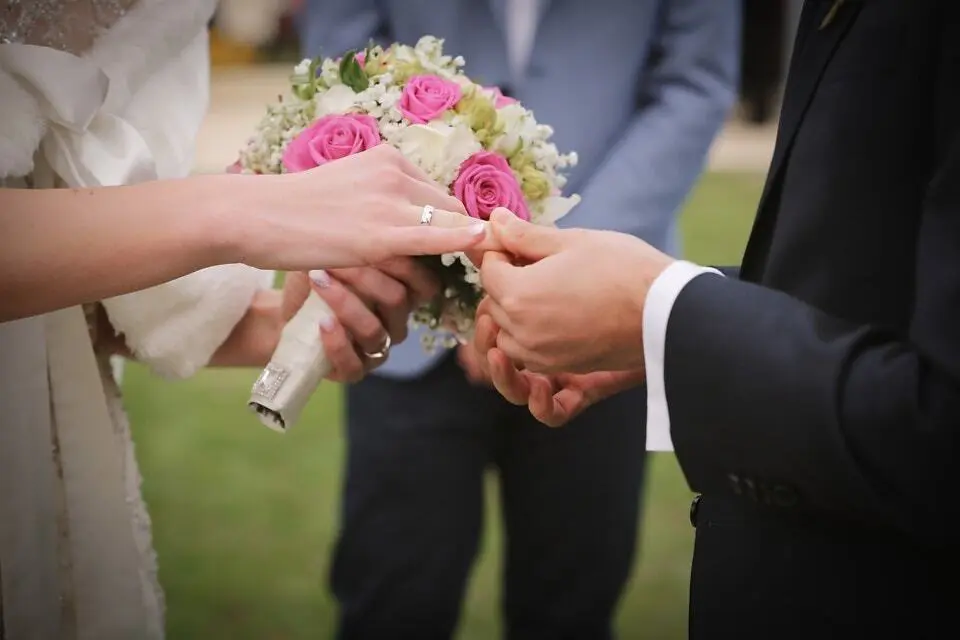
In the months leading up to my marriage, I was regaled with a variety of online content about life as a fiancée as the tech overlords deduced I was about to wed.
One common problem I observed during this period regarded the writing of wedding vows. My wedding occurred just before AI was used for every single creative endeavor that was slightly challenging, so most brides were still spending the days leading up to their wedding carefully editing a loving little speech to read in front of hundreds of their closest friends and family.
Frankly, it sounded exhausting to me, even though I was a professional journalist at the time. The idea of having to put my love for my man into words sounded harder to accomplish than the most complicated story I had ever written. How in the world could a woman put into a two-and-a-half minute speech why she wants to have a man’s children, give her life over to his service and the service of said children, and dive into the great unknown of the rest of her life with his vision for the future to guide her?
Because of this dilemma, I was personally elated that our pastor followed the beautiful vows written in our denomination’s book of church order. At the altar, my husband was asked:
Will you have this woman to be your lawfully wedded wife, to live together after God’s ordinance in the holy estate of marriage? And will you love her as Christ loved the church and gave himself for her, will you comfort her, honor and cherish her, and forsaking all others keep yourself only unto her as long as you both shall live?
I, however, was asked:
Will you have this man to be your lawfully wedded husband, to live together after God’s ordinance in the holy estate of marriage? And will you love him, comfort him, respect and submit to him even as the church submits to Christ, and forsaking all others to keep yourself only unto him as long as you both shall live?
“I will,” we both responded, then repeated the following pledge, “I do promise and covenant before God and these witnesses to be your loving and faithful husband/wife in sickness and in health, in plenty and in want, in joy and in sorrow, as long as we both shall live.”
The focus of these vows, from the Orthodox Presbyterian Church’s Book of Church Order, wasn’t on our particular love story, nor was the focus on the various reasons I was so enamored of my husband and vice versa. Although these things are important, they are not the basis of our marriage. In the end, what binds our marriage is the vows we took before our God, His minister, and our friends and family as witnesses, not how we felt at the time or will feel in the future.
In other words, marriage vows taken from historical, religious forms take the focus off the particular couple and place it where it belongs – on God and the long line of tradition which a couple joins when entering the sacred institution of marriage.
Traditional vows are (to varying degrees) very old, meaning they are tried and true by centuries of use. Thus, in using them, a couple isn’t running the risk of having vows with a reference to a TikTok trend that was funny for eight seconds, or a raunchy joke with which they must live for the rest of their lives knowing their fathers-in-law heard it.
As a bride, I was happy for the ability to repeat a few sentences that wise old men before me wrote to express the solemn nature of the promise I was making to my love. Expressing my love for my husband comes naturally, but I have never once been able to do so in such a succinct, satisfying manner to write in a marriage vow. To me, marital love is so deep that it can only be expressed in a lifetime of faithful service to one another through the trials and joys of life. On my wedding day, it was the time to express publicly what I planned to do about that love – which was to promise and commit my entire life and my entire self to him.
Given my experience, I think other couples might benefit from doing the same. If you’re getting married soon, buck the trend, seek out The Book of Common Prayer or some other liturgical marriage vows, and vow “to love and to cherish in sickness and in health.” Why recreate the wheel when timeless, eloquent, and meaningful marriage vows already exist?
—
This article was made possible by The Fred & Rheta Skelton Center for Cultural Renewal.
Image credit: Pixnio
























Leave a Comment
Your email address will not be published. Required fields are marked with *