
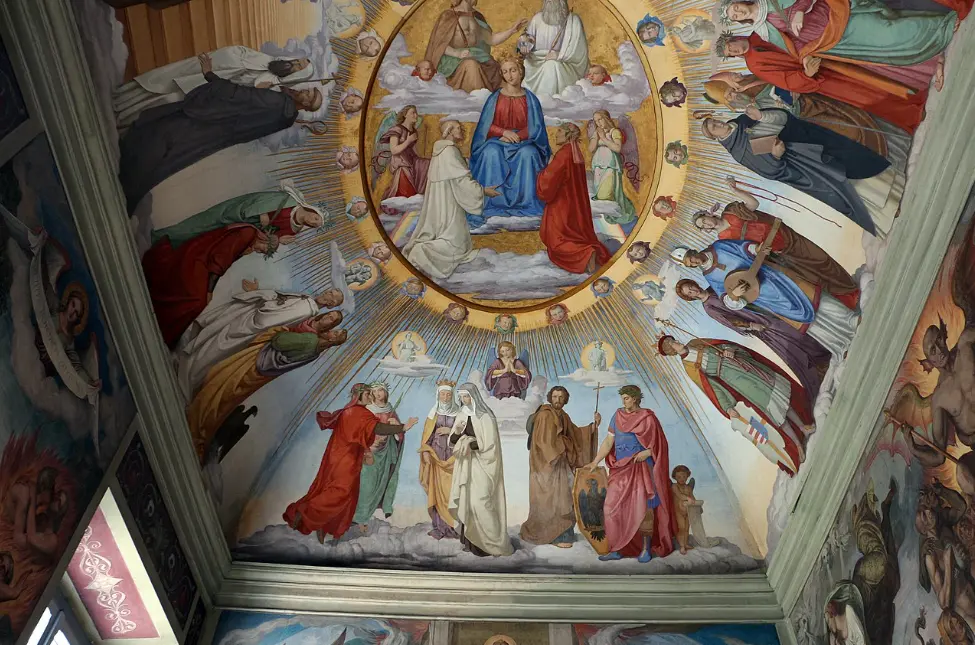
Long considered one of the most influential, provocative, and beautiful works of literature in Western civilization, Dante’s “Divine Comedy” deserves even more attention for its profound spiritual and theological depth.
This might seem obvious as the primary setting for this epic poem are the three destinations of the Christian afterlife: Hell, Purgatory, and Heaven. However, this only scratches the surface as Dante wastes no line nor image in this sprawling work that points one to a deeper understanding of the Christian view of God, goodness and evil, and one’s purpose in life.
Let’s walk with “the pilgrim,” as Dante refers to himself in this work, in order to reflect upon some of the theological insights “Divine Comedy” provides.
“When I had journeyed half of our life’s way” (Line 1)
After finding himself in political exile, Dante was in crisis. He touches on this personal crisis, as well as the common phenomenon of the “mid-life crisis,” when his pilgrim is lost in dark woods and soon takes a tour through the afterlife to face his own mortality.
When Dante describes Heaven, Hell, and Purgatory, he does so in a way that denotes their universality. When Dante describes Hell, his description is meant to point to deeper, truer realities about the very nature of sin, describing the process by which one turns from sin and toward virtue. When Dante describes Heaven, he does not try to replace its biblical descriptions, especially considering that “eye has not seen, and ear has not heard.” Instead, he uses his biblical and scholastic understanding of virtue to paint a beautiful picture of Heaven. Indeed, Christianity recognizes that God is the standard of goodness from which all virtue emanates. Heaven, therefore, is perfect communion with the Source of virtue.
“I found myself within a shadowed forest” (Line 2)
The dark forest is archetypical of danger, uncertainty, and death. Not surprisingly, Dante’s crisis has him wandering and lost because that is just the spiritual state in which he finds himself. It is also where the hero begins his journey beyond the normal world. It includes danger and uncertainty, just as spiritual growth must include the same if it is truly going to be spiritual. Currently, there is too much darkness that prevents him from seeing. But when he later arrives in Heaven, he will find that his vision will be hindered by too much light.
“I tried the lonely slope” (Line 29)
Keeping with Dante’s poetic, mythological imagery, his attempt to walk up the hill in this scene by himself carries more weight than simply moving the narrative forward. In biblical and ancient civilizations, the mountain is notable as the meeting place between humanity and God. The pilgrim attempting to walk up the hill, raising himself to the level of God on his own indicates pride. Pride, the “queen and mother” of sin, will produce the sins in the pilgrim that will block his path. It is not until much later that he will see, when on the terrace of pride, the effect of this sin in hampering his spiritual progress.
The Three Beasts blocking his path (Lines 32, 45, and 49)
The leopard, lion, and wolf presented here are widely interpreted as a representation of Dante’s three major personal sins. They impede Dante’s ascent, are ravenous with hunger, and bring despair. This generic picture may be purposeful as every reader will have a unique set of sins that prevent him or her from ascending to God as well. Indeed, every sin will increasingly seek to satisfy that initial desire, and every sin will only bring despair upon the one seeking something, or Someone, much greater.
Virgil the Guide (Line 79)
Virgil was generously considered by some to be a pagan pseudo-prophet of Christ. This is due to a line from his Eclogue 4, which predicts “the child who’s born,” which Virgil called a “son of Jupiter” (consider that “Jupiter” derives from the words for “god” and “father”), who will “end” the “race of Iron” and usher in a “Golden Age.”
While this was not enough for Dante to put Virgil in his poetic version of Heaven, it was part of the reason why Virgil was a fitting guide to lead Dante through two-thirds of his journey through the afterlife.
The Journey Begins
Virgil tells Dante that his desire to ascend the hill, to commune with God, is a noble one, but he cannot go that way on his own. He must first descend before he can ascend.
This does not mean that a Christian must “go to hell and back” in the sense that he must sin, for sin is never necessary. However, because of Dante’s pride, he wanted to ascend the mountain to God by his own power, and thus he must be humbled, seeing how ugly sin is by its nature. This descent of Dante loosely imitates the descent of God the Son when he took on human nature and Jesus’ descent into death itself. It is after this descent that Dante will be ready to pass through, then up, and finally, beyond.
—
This article was made possible by The Fred & Rheta Skelton Center for Cultural Renewal.
Image credit: Philipp Veit, CC BY 3.0





















Leave a Comment
Your email address will not be published. Required fields are marked with *