
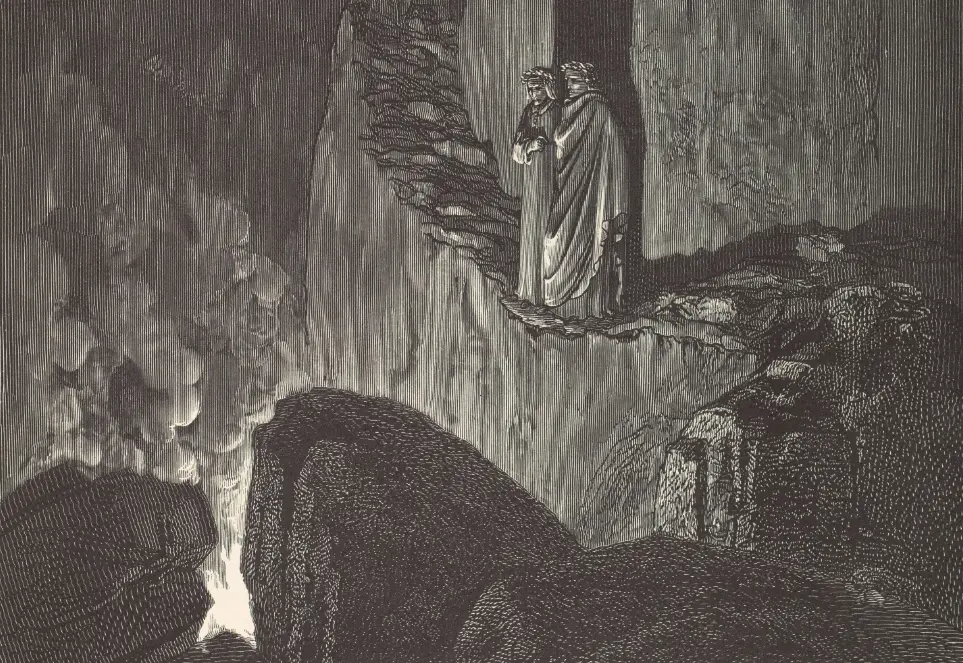
Despite its linguistic beauty and political intrigue, Dante’s “Divine Comedy” is a work of profound theological depth. It reflects the coherence and richness of Medieval Christian philosophy and theology.
“Inferno” the first of three sections in the “Divine Comedy,” follows “the pilgrim” as he journeys through Hell, providing insightful commentary on the nature of sin itself underneath the physical effects that we see in this life. Here are eight of these insights:
1. Sin Has Natural Consequences
The prevailing theme in Dante’s “Inferno” is the contrapasso, which translates to “suffer the opposite.” Contrapasso serves as the basis for the punishments that Dante assigns to the souls of Hell. However, these punishments are not merely cruel or macabre. They are instructive. They show, metaphorically, what the respective sin does to the soul. In other words, the punishment fits the crime.
Dante depicts the souls who committed the sin of lust as constantly thrown about in a violent whirlwind. Through this metaphor, he shows us that lust, which is the subjugation of reason to base sexual desires, leaves us untethered.
2. Sin Clouds the Intellect
According to Christian philosophy, the intellect is damaged by sin because it is a power of the soul, which is always adversely affected by sin. Dante shows this phenomenon multiple times throughout the Inferno through his brief conversations with the shades, which are ghastly spirits, in hell. None of the shades know what is happening in the real world, emphasizing this deadening of the intellect that follows from sin.
3. Sin Is Hierarchical
Many of us might divide sins into the seven categories of the traditional seven deadly sins. Yet Dante divides his circles of hell into nine, a parallel to the Christian tradition of classifying the angels into the nine choirs. The first fallen angel, known to us as the devil, was thrown into hell as a manifestation of his rejection of God. Thus, Dante’s Hell is divided into nine inverted rings, each populated by sinners, whose crimes are proportional to the circle of Hell in which they dwell.
4. Sin Isolates
As one moves downward, deeper into the depths of Hell, one moves away from God. With this downward movement, Dante feels the walls close in on him. This illustrates that sin both isolates one from God and from others. The further down one falls into sin, there less room there is for others to stand alongside. The ultimate result of sin is utter isolation.
5. Sin Affects Relationships
Not every punishment in the “Inferno” is physical, especially as one descends deeper into Hell to view the perpetrators of more grievous sins. These sinners do not only suffer physical anguish, but also separation from others. When simonists (those who buy or sell a church office) are punished, they are buried individually in the ground with their feet facing upwards, then lit on fire. Those who died by suicide stand isolated as cursed trees in a dark forest, clawed away by harpies. Their physical suffering is coupled with aloneness.
6. Sin Overwhelms You
Those suffering from addiction are known to describe their pain as a sensation of drowning. When caught up in a cycle of destructive behavior, it becomes harder to break free. Dante depicts this drowning in his circles dedicated to the sins of wrath and violence against others. These circles consist of souls drowning in either a swampy muck or a river of boiling blood. In both cases, the souls are overwhelmed by their anger and hatred to the point where they cannot escape.
7. Sin Transforms You
One of the most haunting scenes in Dante’s “Inferno” presents the transformation that results from the sin of fraud, which Dante classifies as more abhorrent than violence. In the circle where thieves dwell, the thieves are placed in a pit of snakes whose bites transform them into the snakes themselves. The sinners themselves are transformed into beasts because of their sin.
8. Sin Freezes
Fire is nearly universal in depictions of Hell. However, Dante describes the bottom of hell as a pit of ice rather than flames. Satan is frozen from the waist down; the continuous flapping of his wings cools the waters of Lake Cocytus.
While the Bible does describe Hell as a “furnace of fire” (Matthew 13:42), it also describes God as a “consuming fire” in both the Hebrew Scriptures (Deuteronomy 4:24) and the Christian Scriptures (Hebrews 12:29). Dante, taking these images and descriptions, infers that to be separated from God as a result of sin would make one colder). Satan is the farthest removed from God; therefore, it follows that he is also the coldest.
The imagery of Dante’s “Divine Comedy,” especially “Inferno,” has captivated readers for hundreds of years. Even though it is set in the afterlife, its primary value is found in the wisdom it provides for readers willing to contemplate it in this life. Even the dark and grotesque can be instructive, sometimes especially so.
—
This article was made possible by The Fred & Rheta Skelton Center for Cultural Renewal.
Image credit: Gustave Doré / Dante Alighieri, CC01.0























Leave a Comment
Your email address will not be published. Required fields are marked with *