
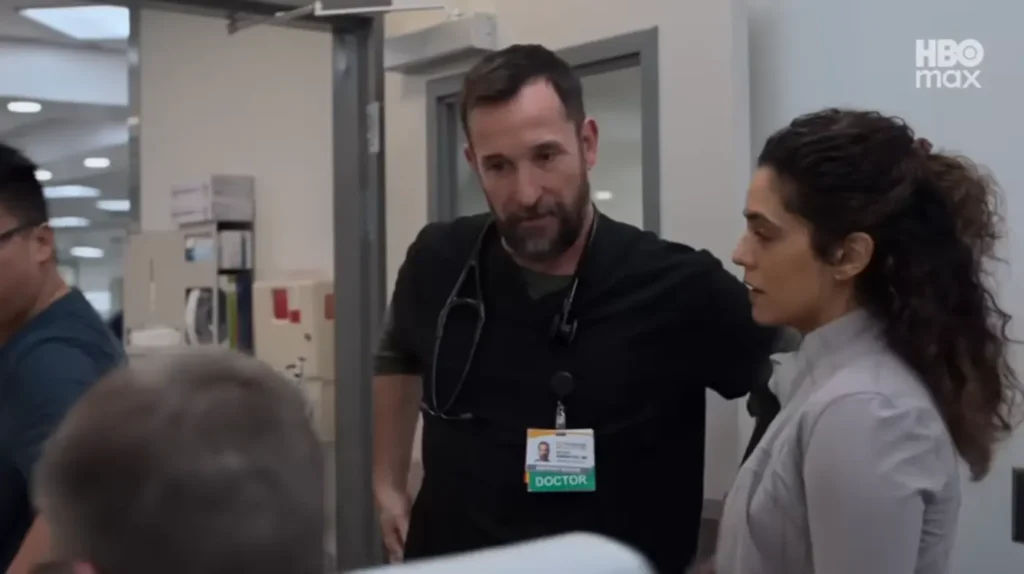
Although one who enjoys a healthy amount of popular culture, I have moved beyond the hope that network television or streaming media is going to purposefully depict Christian philosophical or theological concepts accurately. Thus, I was pleasantly surprised when watching season two of “The Pitt,” HBO’s hit series.
There has been plenty of discussion as to what sets this medical drama apart from others. It is blazing technical trails in how media is filmed and paced, some say. The show’s most notable element is the extremely limited timespan each season covers (only one 15-hour shift). This keeps the show focused on the drama directly related to the work in the hospital itself.
In season two, episode eight, Drs. “Robby” and McKay begin a conversation about a patient with terminal cancer in agonizing pain who is nearing death. “Where are we with the morphine?” Robby asks, suggesting they raise the dosage. After being told (surely for the viewers) “she could stop breathing,” he gestures and asks, “Are you familiar with the doctrine of double effect?”
Previous conversations with my wife who works in health care alerted me that this concept is applied in such settings. What surprised me, however, was that this historically Christian philosophical principle of ethics was presented accurately and non-dismissively.
“We treat pain,” Robby explains. “And if, in doing so, there’s a negative side effect, we accept it.”
“Even if the negative side effect is death?” McKay asks.
While this might seem intuitive to some, its history and reasonability cannot be taken for granted. This doctrine of double effect basically affirms that a good or neutral action may be morally undertaken in good conscience, even if one knows that a secondary bad result will occur from that action.
This concept of the doctrine of double effect was originally proposed by Thomas Aquinas in his teachings about murder. When asking, “Whether it is lawful to kill a man in self-defense,” Aquinas writes, “Nothing hinders one act from having two effects, only one of which is intended, while the other is beside the intention.” This is where the “double” comes from.
“Now moral acts take their species according to what is intended,” Aquinas continues. To clarify, the intention is not the only thing that determines the rightness or wrongness of an action. However, one’s intention can change the moral nature of an act. This is why we distinguish between “manslaughter” and “murder” in law.
The act itself must also be intrinsically good or neutral. An intrinsically disordered action, like intentionally killing an innocent person, is always morally wrong. Also, one’s good intention is not absolute, as circumstances may deem an action unwise and therefore wrong.
In Aquinas’ original presentation, the action was the defending of one’s own life when violently threatened. The person threatened would be justified in defending his own life even if it meant killing the violent aggressor. Because defending one’s own innocent life is a moral good, and would be one’s primary intention, the action would be morally right.
Like the example from “The Pitt,” this application by Aquinas may seem intuitive, yet it is no less necessary to provide the rational, principled foundation for the action. One requires this foundation when considering less obvious, or more emotional, situations that may present themselves. In palliative care, which is heavy-laden with emotions of patients and families, it may not appear so simple, however. Combine this with the increasing practice of Medical Aid in Dying, and the doctrine of double effect applied in this context feels like a convenient circumvention of morality.
This is why the intention remains important for Aquinas and for us. The primary intention in the action that kills the murderer is to protect the innocent. The primary intention in the palliative care patient is to alleviate pain. Yes, large doses can kill a person, and it is possible to use it to directly kill an innocent person. Yet it is the responsibility of the caregivers to know the state of the patient and assess the dose that balances pain management and lethality. This varies by situation. However, the principle, echoing the oath still standard in health care to “do no harm,” remains.
“The Pitt” shows nuance and depth in its realistic presentations of traumatic medical treatment. Fortunately, it also succinctly and accurately provides a foundational concept in the ethical application of those treatments. Hopefully, it can continue to do so in compelling and entertaining ways.
—
This article was made possible by The Fred & Rheta Skelton Center for Cultural Renewal.
Image credit: HBO Max and Warner Bros. TV/YouTube

























Leave a Comment
Your email address will not be published. Required fields are marked with *