
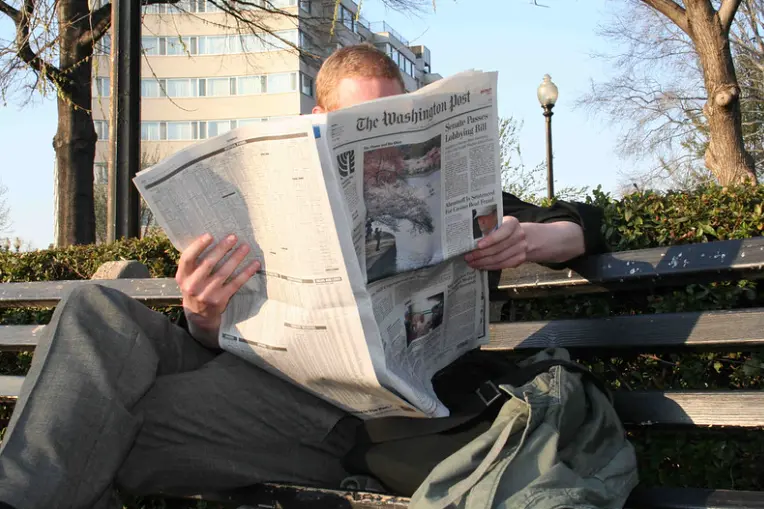
Recently, The Washington Post laid off a third of its newsroom and staff. It’s a monumental act representing the twilight of legacy media, a symbol of the changing information landscape. The one-time gatekeepers of information and “correct opinions” have lost a great deal of credibility, and, with it, profit margins. Jeff Bezos reportedly lost $100 million last year on The Washington Post, and he’d finally had enough, taking a hatchet to his workforce.
This drastic action points to a profound shift in the media ecosystem – a shift providing both opportunities and risks for “the right” or the “alternative media.”
The guerilla warfare of alternative media – largely enabled by the emergence of the internet as a prime news source – has taken a toll on mainstream media. The big budgets and (formerly) big reputations of legacy media outlets have rendered them unadaptable and obsolete as they suffer blow after blow from the alt-media’s hit-and-run tactics, such as James O’Keefe’s undercover cameras.
The legacy media’s highly questionable – or downright dishonest – coverage of subjects like COVID-19 and the so-called Russiagate scandal didn’t help either. We’re living through a crisis of trust in institutions, and media institutions exposed their compromised state on a massive scale.
Americans are waking up to the nefarious forces at work alongside many mainstream media outlets. The natural reaction has been for more Americans to turn to alternative online news sources to get the truth. That shift is both promising and dangerous.
It’s promising because the internet boasts many top-shelf investigators who aren’t beholden to powerful corporate interests or political pressure. The internet has permitted more truthful voices to break through the walls around public consciousness than were ever possible before. Stellar individuals and publications in the alternative space do great work, refreshingly providing voices that aren’t bought out or part of any corrupt system.
Yet the low barrier to entry in online reporting and the growing money to be made has opened the pathway for shills, con-men, amateurs, and wackos – perhaps even psychological operatives – to flood the information market with falsehoods that can be just as damaging as the propaganda that spills out of the legacy media’s mouthpieces.
Too many Americans accept narratives simply because they counteract the mainstream one and align with their newfound suspicion of the institutions. I’m no fan of legacy media, to be clear – but if we’re going to treat their reporting skeptically, demanding proof and digging into conflicts of interest, then we need to treat alternative media outlets the same way, holding them to the same standards. Just because someone proposes a narrative that challenges the mainstream one doesn’t mean that narrative is true. It’s quite possible for both the mainstream and the alternative narratives to be false at the same time.
A lot of Americans on the right seem unable to grasp this. Their understandable and justified sense of betrayal by the legacy media leads them to an emotional response, a contrarianism that isn’t always grounded in the evidence. They apply their critical thinking skills to skewering the nonsense spouted on MSNBC or CNN, but display no such healthy skepticism when evaluating the information offered by citizen journalists and podcasters and random internet bloggers and X accounts – so long as those voices flatter the viewer’s preconceived ideas.
Mainstream media has its own agenda. But so do independent journalists. In other words, independence doesn’t equate to authenticity and trustworthiness. What matters is the truth, and no source in the media landscape has a monopoly on that.
Of course, I’m not attributing malice to every case of disinformation within the alternative media landscape – ignorance arguably plays a bigger role. In addition to the crisis of trust in institutions, we’re also witnessing the “death of expertise.” Because Americans have felt betrayed by our expert class in many fields (medicine, politics, education, etc.), many of us have lost patience with the entire notion of expertise. In typical American fashion we say, “We’ll just do it ourselves.” Who needs experts?
This is why many Americans today are more likely to listen to the commentary of someone who isn’t an expert in the field they’re discussing precisely because they’re not an expert – and, the thinking goes, they therefore aren’t compromised and corrupted.
This is a shallow way of thinking. Just because you can’t trust Dr. Evil doesn’t mean you can therefore trust your neighbor Bill as soon as he puts on a stethoscope. Dr. Evil could be trying to kill you on purpose; Bill could just as easily do it by accident.
While we have legitimate reasons to be skeptical of our expert class, expertise still matters. The topics of discussion in the news will always be complicated and require time, sometimes years of study, to fully understand. What we need are trustworthy experts, not overconfident amateurs, however well-meaning they may be.
If the alt-media is to survive and serve its proper function – which certainly includes challenging and unmasking the corruption in our public institutions – it must avoid discrediting itself the same way that the mainstream media has done. And that requires accountability, discipline, rationality, sober-mindedness, a reasonable belief in the importance of expertise, and a refusal to surrender to groupthink or emotionally-led analysis – not to mention monetary interests.
The alternative media landscape has turned into a bit of a Wild West scenario, and if we are to avoid amplifying narratives that could discredit the entire enterprise, we need to establish more rules and accountability. No matter how this looks in practice, it must involve a commitment to professional journalistic standards including source vetting, processes of peer-review and accountability, and business transparency.
Let’s hope that such standards are implemented soon. Much depends on it.
—
This article was made possible by The Fred & Rheta Skelton Center for Cultural Renewal.
Image credit: Flickr-Elvert Barnes, CC BY 2.0
























Leave a Comment
Your email address will not be published. Required fields are marked with *