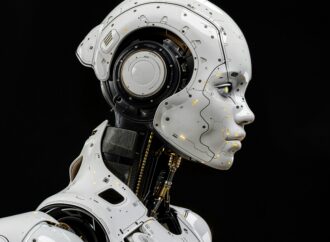

In a recent article for Plough, Paul Kingsnorth posed the following question: “How long will it be, after all, before AI manipulation means that we cannot trust anything we read, see, or hear online? Months? A year?”
Already, AI can generate text, audio, and video that can only barely be distinguished from human-produced content. “Deep fakes” abound.
Kingsnorth’s question isn’t hyperbolic – we’re not far from a point where AI-generated material becomes indistinguishable from the real thing. At that point, the truth and accuracy of everything online will become far more suspect than it already is. The internet will become a murky place where the ground constantly shifts and contact with reality becomes almost impossible.
As a result, the boundaries of what we can know with any great degree of certainty will contract. I’m calling this the “shrinking of the truth horizon.”
I suspect that, out of necessity, we will revert to an older way of acquiring information and with a more limited scope. Knowledge will become much more local and personal in scope. We will be reduced to what we can either (a) personally verify with our own senses (which means events happening in our immediate locality) and (b) what we are told by people we trust. This latter category could include authors or publications, but even such written sources will need careful vetting to verify authorship.
But perhaps we’ve been on the wrong track regarding information for a while now. Maybe it was always a little absurd to believe that we could obtain reliable information about what was happening anywhere in the world at any moment. Such godlike powers were unknown to our forebears, and certainly defy natural human capacity. It’s possible that our confidence in our ability to technologically transcend the barriers to human knowledge was misplaced – even before the advent of AI.
In fact, I’m more convinced that AI developments are just the most obvious and extreme form of a deeper trend that’s been playing out for years.
I firmly believe that reality is objective and knowable. I’m not doubting the human capacity for truth, grounded in our rational nature and the intelligibility of the world. What I am doubting is the effectiveness of the modern method of obtaining truth – through the frictionless process of Google searches. Reality and truth are so buried underneath sophistry, propaganda, competing narratives, and the general artificiality of the online space that I’m increasingly skeptical of the internet’s ability to convey truth.
Of course, there are exceptions – there are certainly truth-seekers and speakers online – but it’s increasingly difficult to cut through the noise to actually hear those voices. Further, the collapse of legacy media and the rise of alternative media fuels the emergence of online grifters and charlatans who pose as anti-establishment truth-seekers challenging mainstream narratives, but who are only interested in money, fame, or division. Their narratives turn out to be as false as those they claim to be correcting.
These questions lead to an even more fundamental one: How do we know things at all? Technology has meddled with a proper understanding of how we know, advancing the illusion that we can attain knowledge and certainty about basically everything, using our own powers of internet investigation and our own powers of reasoning.
People used to think differently about knowledge. Premodern epistemology put God at the center. Thomas Aquinas, for example, held that our reason was a limited participation in the Divine Light. In other words, even our ability to think depends in some way on God – it is not some completely autonomous power. To be used rightly, it must be referred back to Him, submitted to His authority and the voices by which He has chosen to speak to us. For Aquinas, all knowledge comes ultimately from God. It is not so much something we find for ourselves – far less create – but rather something we receive. Truth used to be considered in relation to God and therefore hierarchically. It descended from the higher to the lower, and its wellsprings were found in authority and tradition more than in the individual thinker’s detective skills.
Enlightenment philosophy, by contrast, severed the connection between the reason and God, denying our dependency on Him. Instead, Enlightenment philosophy sought to make the human mind self-sufficient, with personal reasoning and research the sole and final source of truth. Beginning with Descartes, philosophers discarded traditional wisdom and decided they had to dig into every controversy for themselves and come to their own conclusion. That type of intellectual self-assurance characterizes the internet age. But now we’re realizing how full of deception the internet can be, and how limited our knowledge is without God.
What are some more certain grounds of knowledge? The world that is more immediately around us, for one thing. We can have much more certain knowledge of what’s happening in our town or county than we can have about what’s happening in another state or country. We can have more certain knowledge of what others tell us the more fully we know them and their reliability, and that occurs best through face-to-face interactions and genuine relationships.
We can also have clearer understanding of past events compared to present events. With past events, the dust has long since settled and there are usually many sources in agreement.
Finally, the surest ground for our knowledge is in Divine Revelation, the Word of God. These truths are absolutely certain because our knowledge of them does not depend on fallible human reasoning nor questionable human sources, but on God Himself.
A return to this humbler epistemology might be needed in these days of chaos and confusion, galvanized by the sleek circuits of so-called artificial intelligence. If the shrinking of the truth horizon pushes us toward a more traditional, more real way of knowing, then it will be a good thing – a silver lining to the AI cloud.
—
This article was made possible by The Fred & Rheta Skelton Center for Cultural Renewal.
Image credit: Pxhere