
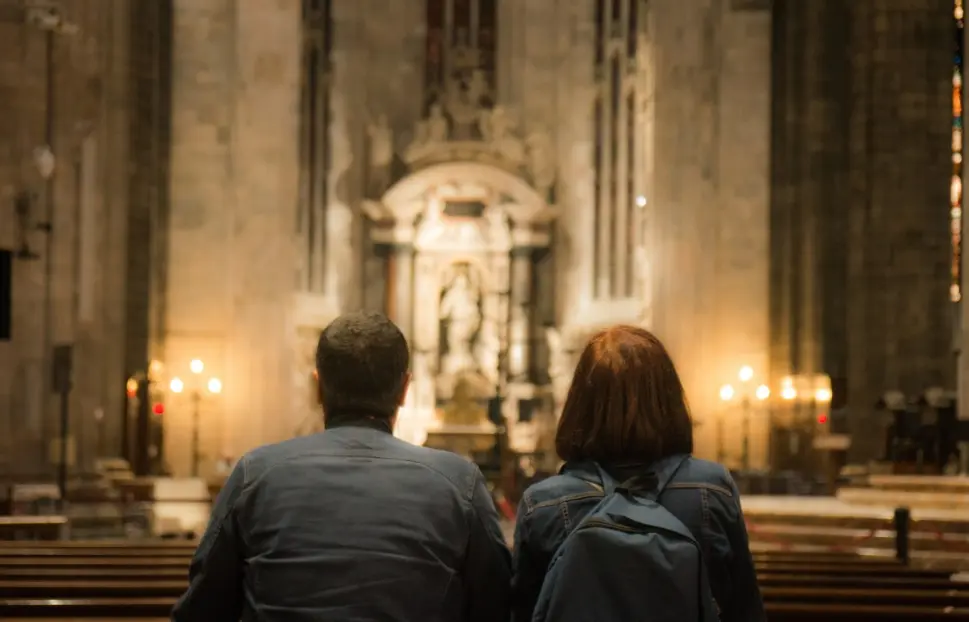
Why does God need my worship? The first response to this question, if one is really talking about God, should be “God doesn’t!” But why doesn’t He?
A common objection to “going to church” is that an all-powerful, all-knowing, all-good God should not need anyone to get together and sing songs about him. It’s true that God does not need anyone to do this because God does not need anything in the way we use that word. Classical theism, the understanding of God’s nature that historically shaped Christian philosophy as well as the philosophies of Plato and Aristotle, considers the divine nature to be impassable.
Impassable means that God does not suffer deficiencies the same way created things do. There is no emotional imbalance or physical pain that God suffers. Divine nature is completely full of every good because it is the Source of all goodness. If the divine nature suffered any deficiency, God would no longer be God. In order for God to be God, and not another part of creation, God cannot have any potential but must be pure act (see “Why God’s ‘what’ matters” and “Why does God have to be perfect goodness”).
Simply put, our worship of God is not for God’s sake but for our sake.
The question of justice
The question of worship is a more specific offshoot of the question of religion. Thomas Aquinas covers the topic of “religion” in his “Summa Theologiae,” but surprisingly places it under the category of “justice” rather than faith.
Aquinas puts religion under justice because the simplest definition of justice is to pay someone what is owed. He recognized that the specific work of religion – worship – revolved around paying back to God or the gods what had been given to humanity, or paying the gods in order to curry favor, so the gods would pay the human community back. While one can dismiss this transactional process as primitive, keep in mind this was the norm for nearly all human history outside of Judeo-Christianity. It is also consistent with justice, even if grace demands something greater.
Then why must I worship?
If worship is a subset of justice, but it is primarily directed at God, which is the highest object, then one’s worship actually becomes the most important work of justice. It is not because God needs it more than other people we are supposed to act justly toward, but because God is a higher good than any other person or thing we can treat justly.
This also does not mean one can neglect treating other people justly, as Christianity considers other people made in God’s image and likeness (Gen. 1:26). The Bible even defines “true religion” as determined by one’s treatment of vulnerable “widows and orphans” (James 1:27). However, this is appropriately coupled with one’s participation in liturgical worship that is directly ordered toward God.
What is worship?
The simplest definition given by Thomas Aquinas is that worship is “the offering of sacrifices … done out of reverence for God.” This can include many things like sacrifice of time, energy, attention, talents, and money. Despite the liberal variety this offers, it does not mean that there are no parameters to its proper practice.
When we treat people justly, there must be cooperation with that person. It would not be just if we did not pay them back in a way they did not agree. Similarly, when we give God worship, it must be along God’s terms, not ours. There are parameters to these terms of worship that each faith tradition has established. For Christians, it is one’s responsibility to examine the context of these terms of worship in order to determine which ones adhere most closely to what God has established.
Do I actually need to go somewhere to worship?
Our soul is the part of us that makes us capable of thinking about God, giving thanks to God and worshiping God. Therefore, it seems like one only needs the soul in order to worship God. If this is true, then why does it matter where one’s body is at all?
While the soul makes us capable of worshipping God, it is also possible to think about and worship God wherever one’s body is. However, in order for one’s worship to be perfected, it must participate in something beyond it. Just like our thoughts are influenced by our senses, so too are our souls drawn into a deeper understanding and love of God by sensible things. The space that is built for and filled with these sensible things would be a space that perfects one’s worship.
Does worship actually do anything?
Of course! Even if God is not changed by our worship, we definitely are. If we worship honestly, not putting on a show to get attention or honor, then something will happen within us. Aquinas actually identifies authentic worship with sanctity because worship connects a person to the object of that worship. The word, religion, comes from the word “to bind” because the practice is supposed to bind a person to God.
To understand what happens in us when we participate in worship relies on worship’s connection to the virtue of justice. If religion, of which worship is a part, is connected to justice, then to develop one’s sense of religion through our participation in worship is to grow in one specific area of justice. If worship is directed toward God, then it is connecting that person to God.
After all, our worship of God is not for God’s sake but for our sakes.
—
This article was made possible by The Fred & Rheta Skelton Center for Cultural Renewal.
Image credit: Pxhere























Leave a Comment
Your email address will not be published. Required fields are marked with *