
Do historical objects matter? Are ancient artifacts anything more than old scraps of paper, moth-eaten fragments of fabric, or rusty hunks of metal?
In frenetic modern life, with its emphasis on the now and the brand new, most people are more concerned with owning the latest iPhone than owning some relic of the past. But that’s a mistake.
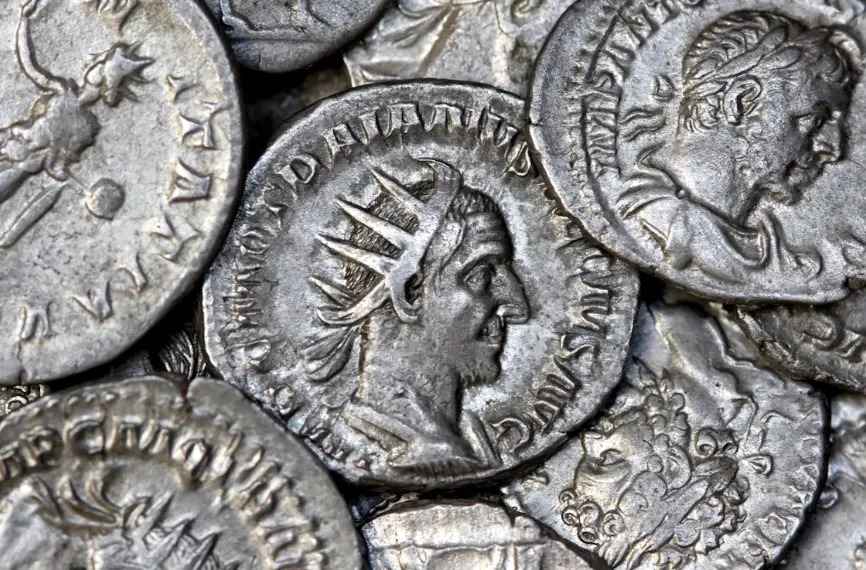
Let me illustrate. Recently, I purchased four ancient Roman coins, dating from the late A.D. 200s to the late 300s. On one side, they bear the firm visages of Roman emperors gazing into the distance. On the other, they depict human figures and the standards of the legions, symbols of the Roman military might that made them masters of the world.
One coin is from the Emperor Constantine’s era. Some Roman citizen likely held this same coin in his hand, perhaps used it to buy hot food at a thermopolium in February A.D. 313 while processing the incredible news: Emperor Constantine had issued a new edict ending the persecution of Christians within the empire. Christianity was officially free. The painful days were over, and no more Christians would shed their blood beneath the imperious gaze of Roman statesman and the drooling Roman mobs.
Perhaps that same coin was still kicking around over 60 years later, in A.D. 380, when Emperor Theodosius I made Christianity the official state religion of the Roman Empire. Christianity transformed from a harried and hindered fringe cult, hiding in the catacombs to survive, into the official religion of the entity that had once tried to eradicate it. Christendom had begun.
These coins bear the marks of history, imprinted forever into their scuffed bronze faces, carrying the dust of century upon century, linking me to the very foundations of modern civilization.
Artifacts tell a story. And when I say “story,” I don’t mean simply an entertaining narrative – I mean the story – the story of us, the story of which we are a part. As G. K. Chesterton wrote in “All I Survey”: “The disadvantage of men not knowing the past is that they do not know the present. History is a hill or high point of vantage, from which along men see the town in which they live or the age in which they are living.” So remnants of history, like coins, urge us to compare ourselves with the past while we take stock of the future.
My little collection of Roman coins reminds me to reflect on my place within a larger timeline. It encourages me to cast my glance both backward and forward.
Backward, because Western civilization does not exist without the Romans and their military and economic might, immortalized in these little circles of metal. Though we seem bound and determined to forget it, we inherited crucial elements of our cultural DNA from the Romans: from our political and legal system to foundational philosophical thinkers and ideas to military strategy and organization and architectural and engineering breakthroughs. The Romans – along with the Greeks – bequeathed to us ideas about family, freedom, order, nobility, beauty, and what it means to be a citizen. An artifact like a coin reminds us of all this, of where we’ve been, and the swirling eddies and winding currents of history that have led us to our current moment.
At the same time, these artifacts draw our attention to the future. What artifacts will we, in turn, leave behind (besides all our plastic waste)? I speak not only of physical artifacts but also the legacy of our deeds, our beliefs, our institutions, monuments. Will it be a legacy of honor and hope, or one of tragedy, moral decay, and cultural putrefaction?
America stands at a crossroads. Will she be remembered, ages hence, like the Romans – a flawed but valiant people who, for all their faults and eventual decline, gave the world, at their peak, a flicker of hope, a sudden surge of greatness, and a decisive contribution to the fruitful development of human civilization? Or will we be looked at as a people who fell short, lost their way, and wasted and wore away their cultural heritage? Will future peoples look at an American penny the way I look at my Roman coins?
The decision is ours. And sometimes something as simple as a little worn piece of metal, glinting faintly in the sun, as though burning faintly with the flame that keep civilization alive, can help us remember the weight of our responsibility.
—
This article was made possible by The Fred & Rheta Skelton Center for Cultural Renewal.
Image credit: Pexels





















Leave a Comment
Your email address will not be published. Required fields are marked with *