
I’ve never used ChatGPT. Nor have I used Claude, Grok, or Gemini. At least, I don’t think I have. Large language models, artificial intelligence, and technologies that use them are spreading so fast that it’s impossible for me to say with certainty that I’ve stayed away from them. But I’m doing my darnedest.
The downsides to these AI tools are so apparent to me that I can’t imagine incorporating them into my life, at least in their current form. From their creators’ piratical disregard for privacy and copyright to the measurable deleterious effects on users’ brains to the slop that passes for “useful output,” there’s nothing about AI tools that is the least bit attractive.
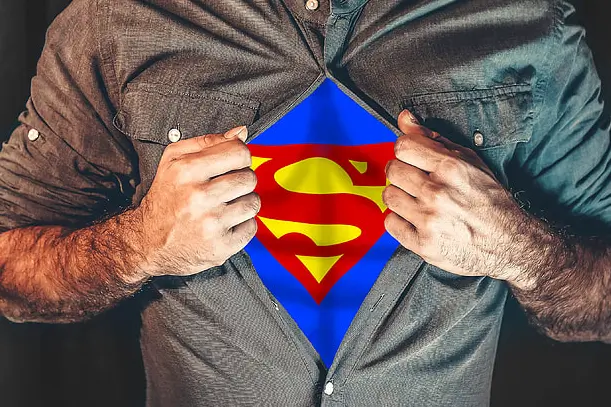
Except one thing: artificial intelligence has made me superhuman.
Not “super” in the sense of “above” or “beyond” human, but super in the everyday sense of “very, very” human.
When Facebook became widespread, people were able to share experiences with friends, even if they lived far away. Photos of beach vacations, kids’ birthday parties, Christmas celebrations – all immediately available. In the early days of Twitter, I was delighted to have direct access to writers, movie directors, and journalists who shared thoughts and insights about their various fields. With the arrival of live video streaming, people could watch games, performances, even church services without leaving their homes. It was exactly like being there.
Except it wasn’t. Social media – and the internet in general – tricks us into thinking we are closer to our friends than we are. The truth is, everything we see online is mediated through a screen, and screens often distort reality. Facebook photos are curated. Twitter feeds are arbitrary. Live video eliminates three of the five senses. Artificial intelligence merely makes the distortion more obvious. Now, people are finally coming to grips with the fact that anything they see online, no matter how real it looks, may be completely fake.
That is a very good thing. Hopefully, the stink of AI slop will drive people away from social media and get them back into the habit of hanging out with people in person. Hopefully, people will be so frustrated by AI photos, illustrations, and movies that they will return to the classics and discover the beauty and creativity of Ansel Adams, Bill Watterson, and David Lean. Hopefully, theaters will re-open because the masses will clamor for places where they can be entertained by real people in the company of real people. Hopefully, AI will make everyone super human.
I hope the same thing goes for writing. I hope the sobering truth that the latest novel or newsletter may have been written by a chatbot with no more knowledge of the world than it can scavenge from a database shocks people into seeking out old books, classics that have stood the test of time and poetry that was composed painstakingly by human thought instead of instantaneously by electric signals. I hope people will recognize Twitter and YouTube for the regurgitation factories they are and seek insight in the work of human beings who write and think at a human pace.
As someone who has never used AI and avoids its output whenever possible, I feel like I have superpowers. I can actually read a book and understand it. I can remember a state capital without asking ChatGPT. I can sit in one spot and slave over a poem or essay without asking a robot to do it for me. Best of all, I can do nothing. I don’t feel the urge to have my AI slave working in the background all the time. I can just … be.
In a decade, perhaps even less, people will ask what has become of society and another Jonathan Haidt will write a book titled “The Stupid Generation,” wherein he explains how the rise of ChatGPT turned an entire nation into a pack of idiots, just as the rise of social media turned teenagers into nervous wrecks.
Don’t fall for it again. You don’t have to use ChatGPT just because everyone else does. Seriously. Heed this wild-eyed prophet. Be kind to your future self. Become superhuman.
—
This article was made possible by The Fred & Rheta Skelton Center for Cultural Renewal.
Image credit: Pickpik




















Leave a Comment
Your email address will not be published. Required fields are marked with *