
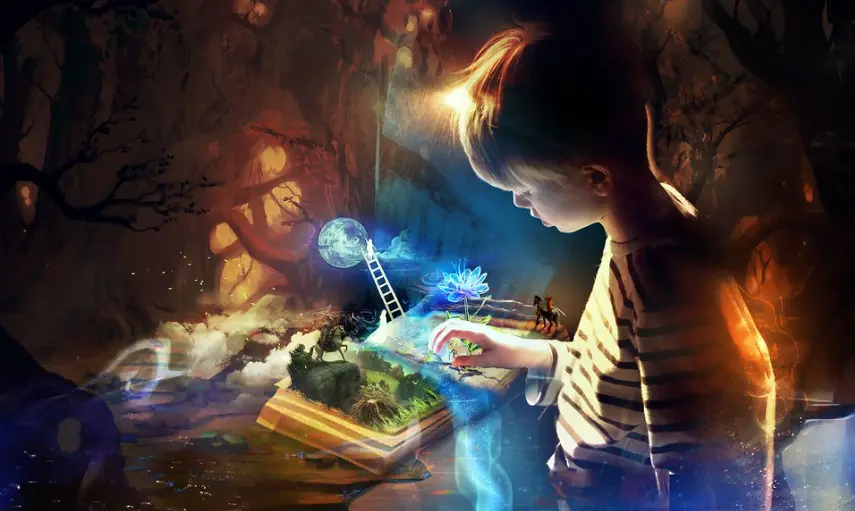
Much of a child’s education happens outside the classroom and begins long before he first sits down at a desk. Like a plant, a toddler draws nutrients from his surroundings, the “soil” of the home environment, almost as soon as he can recognize mom’s face. This soil forms the basis of the child’s future formalized education, the ground in which he will grow and bloom intellectually, emotionally, and physically. It pays to make that soil as rich as possible.
Why does the child’s environment matter years before he ever enters a classroom? Unfortunately, modern education has so narrowed the concept of education that we think of it solely as book learning and math worksheets. But true education involves the whole person – body, mind, memory, emotion, and imagination. All these faculties are shaped by early childhood experiences, but none might be so vital as imagination.
As Aristotle explains in “On the Soul,” whenever we think about something, we conceptualize it along with an image. For example, when we think about dogs, we call to mind the look, smell, or feel of a dog. That image, in turn, affects how we think about the concept.
This is true even of abstract concepts like “justice.” For one person, the sensory image associated with justice might be a courtroom or a judge, for another it’s Superman, for a third, King Arthur. These mental images aren’t irrelevant; they color our perception in subtle yet crucial ways. The concept of justice strikes a different note when associated with King Arthur than it does when associated with Superman. These two concepts are not identical, even though the word is the same.
The development of our children’s imaginations matters because concepts are digested through the imagination and later fed to the conscious mind. As a result, the images that our children associate with concepts will inevitably shape their perception of the world. Educator John Senior went so far as to argue that if the imagination becomes corrupted, it will eventually lead to errors in reasoning and false ideas about reality. The imagination provides the raw material with which the reason builds; if that raw material is of poor quality, then the reason’s constructions will also be weak and flawed.
By contrast, a healthy imagination enables children to assess the world and react to it in a healthy way. Aristotle believed that the essence of education lay here: in forming the right responses to good and evil, not just intellectually but also emotionally and imaginatively. “[V]irtue consists in rejoicing and loving and hating aright,” Aristotle wrote in “Politics,” and “there is clearly nothing which we are so much concerned to acquire and to cultivate as the power of forming right judgments, and of taking delight in good dispositions and noble actions.”
Aristotle’s approach is to integrate body and mind, reason and emotion, memory and imagination, so that the whole person is formed to both make right judgments and delight in the good.
The environment and experiences of childhood already begin to form and educate children, even if these experiences have no obvious academic element. This is why it’s so important to surround children with grounded, tactile encounters with God’s creation and good, beautiful, and noble sensory inputs to feed their imaginations.
A few practical suggestions:
- Let children experience the natural world that God made, both out in nature and with animals and through encountering objects and toys in the home that are made from natural materials – wood, wool, stone, etc.
- Fill children’s ears with beautiful, ordered music: classical pieces, traditional folk songs, hymns.
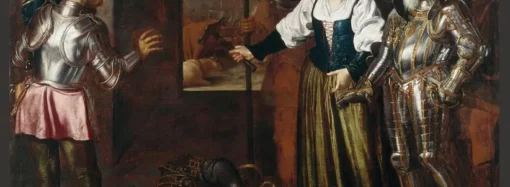
- Open children’s eyes to beautiful art by hanging classic paintings on the walls and only buying picture books with high-quality illustrations.
- Introduce children to the beauty of ordered language through nursery rhymes, poems, and prayers.
- Form children’s minds and worldview through contact with classic, time-tested stories.
- Strictly limit technology usage.
- Whenever possible, cut out the ugly, banal, or disordered in children’s books, games, movies, music, toys, and so on.
Everything we take in through our senses enters the imagination and the memory; it becomes part of us. Just as we want to give our children healthy food to become part of their body, we want to give them healthy sensory, imaginative, and emotional inputs to become part of their souls and shape them in an upright manner.
—
This article was made possible by The Fred & Rheta Skelton Center for Cultural Renewal.
Image credit: Flickr



















Leave a Comment
Your email address will not be published. Required fields are marked with *