
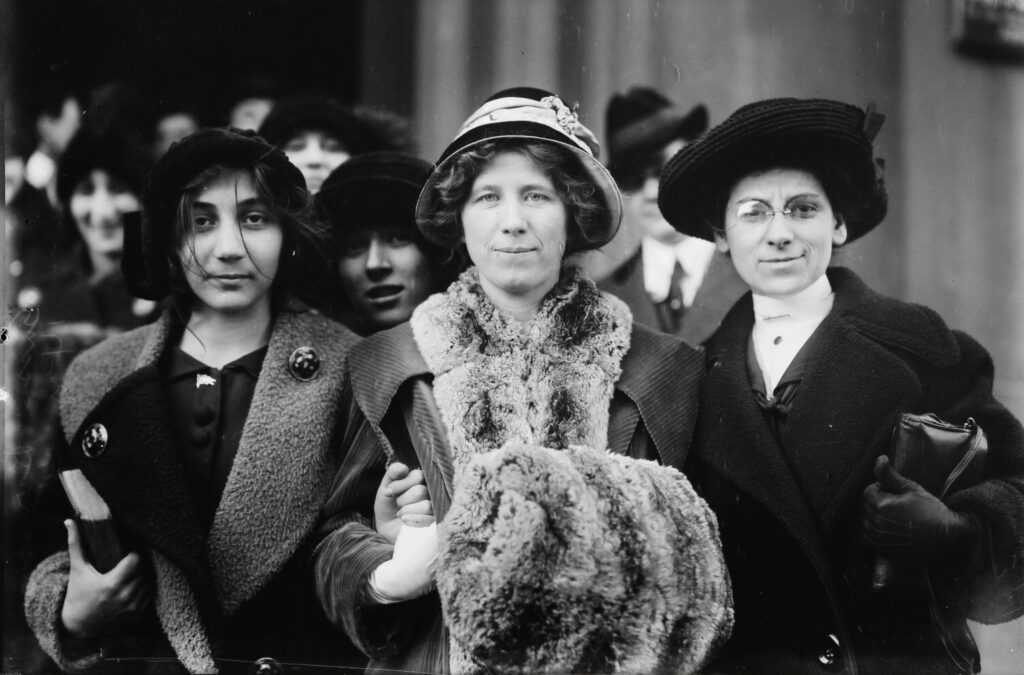
For those of us who enjoy exploring history, looking over the shoulder into the past provides pleasures and new insights. The sensation is like opening some dusty trunk in Grandma’s attic and playing detective without leaving the comfort of your living room.
For instance, while researching Harriet Beecher Stowe, I was recently surprised to learn that she was an anti-suffragist. Her sister Catharine, a staunch advocate for women’s education, was, if anything, more strongly opposed to the vote for women. Intrigued, I opened that online attic trunk and discovered that millions of women agreed with the Stowe sisters.
Until that historical dive, I always believed that misogynistic men, or the patriarchy, constituted the chief resistance to women’s suffrage and the 19th Amendment. Yet women who opposed their sex receiving the vote or who were indifferent to the issue far outnumbered the suffragettes.
Why were so many women opposed to opening the franchise to their sex?
Catherine Mambretti’s 1978 article “The Burden of the Ballot” gets to the heart of this question. Some main objections of the anti-suffragettes were that suffrage “threatened both to topple women’s pedestals, carefully ensconced in the home, and to end chivalry.”
But anti-suffragettes believed the real issue lay in “the nature of womanhood and the family,” Mambretti writes. “The very foundation of American life risked destruction should women gain the vote….” She continues, “Families held the nation together, and mothers held families together.”
That idea is long gone. Our culture’s radical emphasis on individualism has relegated the family to the back of the bus. The present obsession with the self would have struck most Victorians as unnatural and egotistic. And as anyone who has read William Ross Wallace’s popular 19th-century poem is aware, that era venerated motherhood. Its title alone, “The Hand That Rocks the Cradle Is the Hand That Rules the World,” sums up the spirit of the age.
Anti-suffragettes, Mambretti points out, believed that with the vote, many women might lose interest in motherhood altogether:
Writer Caroline Corbin warned, ‘When political rewards are offered [to women] … do you not believe that many, and those not of the weak and ignorant, but of the more gifted and intellectual, will be tempted to forgo marriage and motherhood for the sake of winning them? Woe betide the land which thus offers its political trusts as premiums for childless women!’ Even women who might still consent to bear children might be inclined, as some suffragists proposed, to leave their children’s care to institutions, or husbands might be asked to share in child-care duties.
I pulled Caroline Corbin from the trunk next. Initially an advocate for women’s suffrage, she reversed course. Julia Flynn and Lori Osborne give this explanation for her change of mind:
Although research could not reveal an exact reason why, sometime after meeting with Karl Marx’s daughter Eleanor in 1886 and delving deeply into Socialism as a political institution, Corbin’s opinion on woman’s suffrage changed. Her support for obtaining the right to vote strongly became a fight against it. She was concerned the good moral order of a Christian society would be destroyed by Socialism and that if women were awarded the vote, family and society would unravel. More can be found in this pamphlet. Corbin wrote called ‘One Woman’s Experience with Emancipation.’
Some of the radicals supporting women’s suffrage, and some who, like today’s fringe feminists, pitched camp beyond the borders of eccentricity, were another reason women like Corbin opposed the movement. “For women who were not terribly political themselves, that was the decisive argument against suffrage: half the women arguing in favour of it seemed to be utterly daft,” Helen Andrews writes.
On that note, let me add that you’re mistaken if you think I’m advocating some sort of Victorian throwback. That’s water long under the bridge. I will add, however, that a century of feminism, particularly in the last 50 years, has muddled male-female roles in our culture, a losing game for both sexes. I’ll conclude with the last paragraph of Mambretti’s essay:
The anti-suffragists feared enfranchisement and the equality it promised. But despite their misogynist rhetoric, while suffragists preached sexual equality, some Antis secretly harbored visions of female superiority, which, said one Anti, the woman’s movement threatened to end: ‘It is a movement backwards toward men and mastodon, the miocène hipparion and eocene anchitherium—instead of forward, in the direction of woman, and the spiritual universe, and everlasting light- and there is not a man… who would not tell you so if he were only woman enough to know what I am talking about!’
These days, with that everlasting light dimming as never before, a lot of men are woman enough to understand exactly what she’s talking about.
—
This article was made possible by The Fred & Rheta Skelton Center for Cultural Renewal.
Image credit: Unsplash





















Leave a Comment
Your email address will not be published. Required fields are marked with *