
In his beautiful essay “A Remaining Christmas,” author Hilaire Belloc reminds us of the importance of intergenerational traditions that surround and adorn holy days like a wreath. Christmas traditions keep us grounded in our bodily human nature, Belloc explains. “Man has a body as well as a soul, and the whole of man, soul and body, is nourished sanely by a multiplicity of observed traditional things,” he writes.
Christmas traditions that repeat year after year offer us a glimpse of eternity, helping us transcend the changes, sufferings, and losses that occur with each passing year. “[T]here is this great quality in the unchanging practice of Holy Seasons, that it makes explicable, tolerable, and normal what is otherwise a shocking and intolerable and even in the fullest sense, abnormal thing,” Belloc writes. “I mean, the mortality of immortal men.”
He goes on to note that all the vicissitudes and trials of every year can become part of a larger redemptive narrative when linked by traditional holy days and their celebration in the same way every year:
[A]ll the bitterness of living—become[s] … connected in the memory with holy day after holy day, year by year, binding the generations together; carrying on even in this world, as it were, the life of the dead and giving corporate substance, permanence and stability….
Christmas traditions are about a lot more than mere sentimentality, Belloc teaches. They’re precious things, not to be thoughtlessly discarded.
Unfortunately, many Christmas traditions have been lost and one must search them out, brush them off, and rebuild them. Here are seven Christmas traditions to consider bringing back this year.
1. The 12 Days
The first tradition for us to recover is a proper framework in which to celebrate Christmas. Traditionally, Christmas is not just one day – it is 12 days of celebrations that begin on Christmas (not before) and last until Jan. 6. The days leading up to Christmas used to be days of penance and preparation. The modern trend has completely reversed things, spending about 10 or 12 days having parties leading up to Christmas (with no penance or preparation, of course) and then packing it all away on the 26th – the day our ancestors were just getting started!
2. The Yule Log
This tradition goes back to at least the Middle Ages. It involves lugging a large, solid log into your fireplace or firepit and lighting it on Christmas day. The goal is to keep it burning as long as possible – ideally, all the way until Epiphany (Jan. 6). At that point, the log’s remnants are removed and stored until next year, when they’re used to light the new Yule Log. Each year is thus linked by the light and warmth of the family Yule Log, interpenetrating the next year with the heat of its memories and celebrations.
3. Flaming Pudding
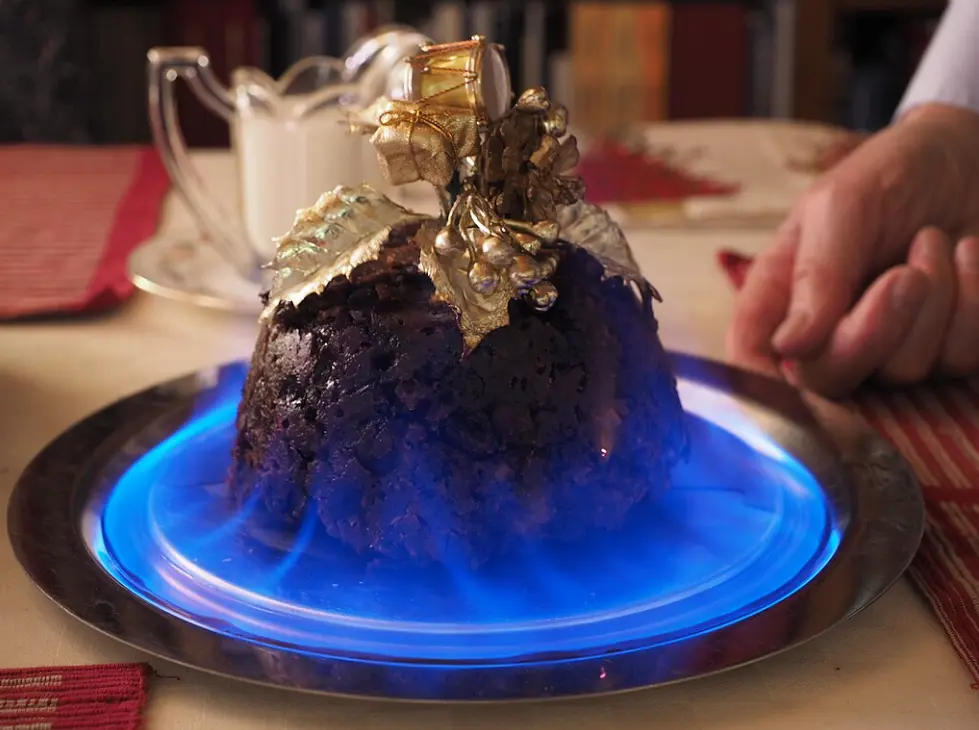
Traditionally, the Christmas pudding is brought out on Christmas Day and doused in brandy. The brandy is then set on fire, creating a beautiful, festive, flaming dessert!
4. Boxing Day/St. Stephen’s Day
The day after Christmas was historically a day for works of charity. Wealthier families would put together boxes containing gifts and money and distribute them to servants, tenants, craftsmen, widows, etc. As my friends over at Sword&Spade magazine write, Boxing Day is a great day to remind your children that “Christmas joy is not supposed to collapse inward towards the self but to go out into the world and bring the light of Christ to all.”
5. Parlor Games
The Victorians loved to play parlor games during the holiday season; indeed, these simple, humorous games are the perfect way to bring together family and friends and live out the festive spirit. These games can usually be played with a large group of various ages and often involve as much silliness as skill. From charades to forfeits to wink murder, there’s something to enliven every party amidst the many circle games our ancestors played on long winter evenings.
6. Caroling
Fortunately, this tradition hasn’t been completely lost. Still, it’s not common for people to march about from door to door singing Christmas songs. Most neighborhoods don’t operate that way anymore. But why not? Nothing brings the community together like sharing festive music. If you don’t live in a neighborhood, consider caroling at a nursing home, spreading cheer to elderly folks who may not get a lot of it during this time of year. My family has done this many times and it’s always a rewarding experience.
7. Twelfth Night Ball and Celebrations
Historically, the holiday season ended with a bang the 12th night after Christmas (yes, this is the day Shakespeare’s play is named after), involving masked balls, games, and other revels. This would be a great day to host a ballroom dance. Another Twelfth Night tradition involves the “King Cake.” A cake is baked with a prize inside (maybe a silver dollar or a plastic doll), and whoever has the prize in their slice of cake is crowned “Lord of Misrule.” This lucky lad or lass gets to pick all the games and other festivities for the day.
Of course, every family has their own set of Christmas traditions. But it’s worth considering adding some of the above to your routine, for all the reasons Belloc so beautifully laid out for us.
—
This article was made possible by The Fred & Rheta Skelton Center for Cultural Renewal, a project of 1819 News.
Image Credit: Flickr-James E. Petts, CC BY-SA 2.0

















Leave a Comment
Your email address will not be published. Required fields are marked with *