
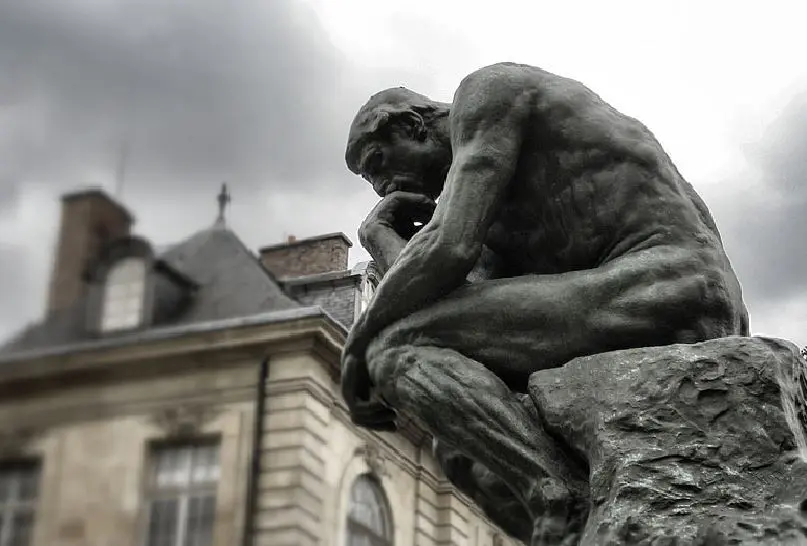
“All men by nature desire to know.” These words begin Aristotle’s “Metaphysics,” one of the most influential books in the history of philosophy, and describe something essential about our human nature. Our minds desire to know because we need to survive, and knowledge does play a role in survival, but our minds also desire to know information about the world because our minds are designed to participate in the truth.
In previous articles, I discussed questions related to whether we can know the essence of something, the role that physical bodies play in determining what something is, and the tools of the intellect one would use to know something with certainty. These questions all relate to what classical philosophy considers to be the origin of knowledge itself, namely, being itself.
The concept of being itself is the object of metaphysics, the basis for every other branch of philosophy including epistemology, the study of knowledge. Knowledge would then be considered the mind’s recognition of a reality that exists outside the mind.
Participating in Reality
For Thomas Aquinas, all of reality participates in “being itself,” which he identifies as God. This means that reality, the basis for knowledge, participates in God. This is not just an arbitrary declaration from Aquinas or classical philosophy. It flows directly from what reason can tell us about the nature of God. For example, in one of Thomas’ famous five ways to the existence of God, he argues that God is the “efficient cause” of all reality. This is distinguished from God as the “unmoved mover,” an argument originally proposed by Aristotle, but the upholding cause of every continual moment of existence. This includes upholding the existence of substances as they maintain what they are. If God is continuing to uphold the existence of substances, then the form of these substances must be present in God’s mind at every moment as well.
Thomas also demonstrates how God is the “standard of being” as well as the efficient cause. This means that God is not just another participant in reality like created things, but that which determines the reality of everything else. This means that all reality, the basis of knowledge, participates within God’s being. From this, it follows that all knowledge participates within God’s being as well.
The Intellect and the Body
For Aquinas, our ability to know something is the product of our rational soul. This flows from the intellect, one of the two powers of the soul. Because the substance, or nature, of something is immaterial, the means by which we know the substance of something must also be immaterial. However, the nature of things is communicated through physical bodies, and so our knowledge of them is received through a physical thing, our brain. It is in this section that one finds one of Aquinas’ most famous sayings, that knowledge is “received…according to the mode of the receiver.” Knowledge of things like sight, sound, or smell is communicated through the things that receive these sensations: the eye, the ear, and the nose. Similarly, knowledge of non-sensible things like ideas must be communicated and received through the intellect.
This means that humans can receive knowledge of immaterial substances because of our rational soul, but must receive this knowledge through physical bodies. This is what makes our physical brain so important to knowledge. This explains why we rely so heavily on images and analogies to communicate knowledge about abstract ideas.
Coherence with Truth
For Aquinas, knowledge of non-physical substances, the essence of something, was present in physical objects and could be communicated through the physical brain. However, the knowledge itself is immaterial, meaning it could only be known in an immaterial substance, which Aristotle and Aquinas both recognized as intellect, one of the two powers of the soul.
Because knowledge is our intellect’s coherence with the truth, and truth is dependent on reality, then knowledge itself is a participation in reality itself. Aquinas recognized God not as another being participating in reality, but the ground of reality itself. This means that knowledge, because it coheres to truth, participates in the ground of reality, God’s nature.
Our knowledge, and the certainty we can derive from it, fortunately is not entirely dependent on us. Knowledge proceeds from something that exists independently of us, the knower. This can actually give us confidence in both the reality of something other than ourselves as well as our own existence (at least it helped Descartes). Even for one who does not want to call that cause “God,” one must still acknowledge that this cause transcends every individual true thing, considered by classical philosophy and Christianity to be Truth itself.
—
This article was made possible by The Fred & Rheta Skelton Center for Cultural Renewal.
Image credit: PickPik





















Leave a Comment
Your email address will not be published. Required fields are marked with *