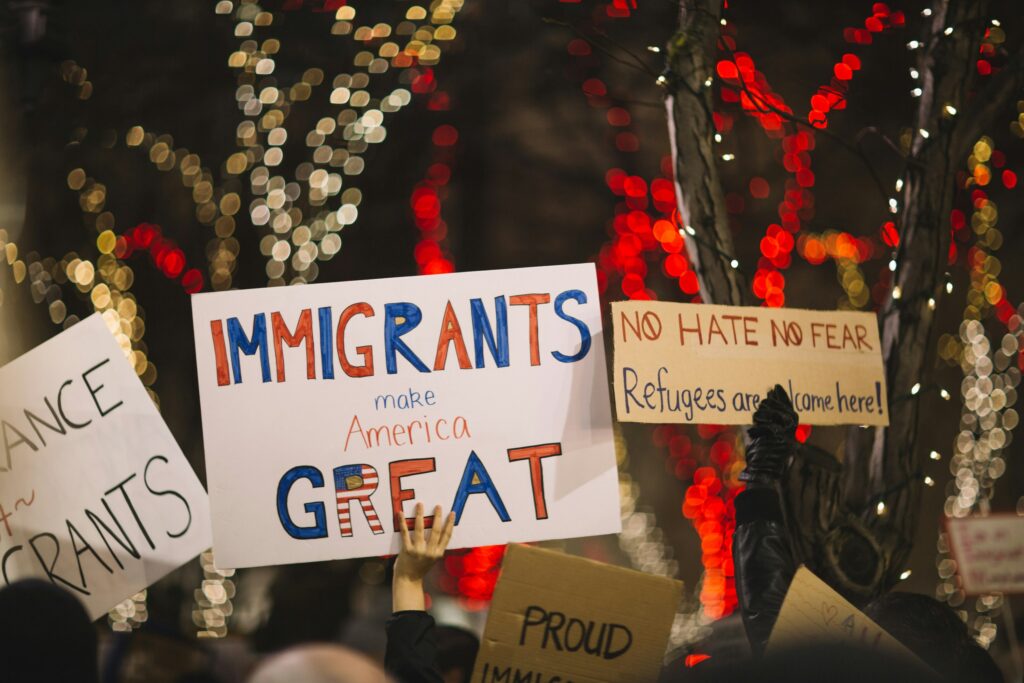
In 2024, the Israel-Palestine conflict incited protests, sit-ins, and marches across American college campuses. Although this debate is far from over, a new cause has taken precedence among young Americans: protesting deportations, arrests, and violence at the hands of Immigration and Customs Enforcement (ICE) officers. Both issues bring the age-old question of free speech versus hate speech to college campuses.
Consider the following examples.
In February, Pennsylvania State University launched an investigation into a flyer found on campus, unaffiliated with any official student group, that read “Dead ICE Agents Can’t Kill.” The flyer featured an image of an agent with a noose around his neck.
Around the same time, University of Illinois Urbana-Champaign student Republican group (“Illini Republicans”) shared an Instagram graphic with a cartoonified image of Alex Pretti moments before he was shot by an ICE officer. “Only Traitors Help Invaders” was written below the image. The Illini Republicans were reported to the university’s Title IX office, which investigates civil rights violations.
Both posters are incidents of incredibly poor taste. Both posters glorify violence. But are the schools justified in investigating these graphics as civil rights violations?
I believe the answer is a resounding no. To prohibit individuals from expressing these ideas – no matter how offensive or distasteful – is to promote censorship.
I am not defending either poster. Both are morally reprehensible. They also present oversimplified, black-and-white depictions of what is an incredibly nuanced issue.
But do these facts mean that the creators of these statements should not be allowed to express these views?
Cracking down on speech and expression is a dangerous and slippery slope. If the government decides today that “offensiveness” is grounds for censorship, how many millions of Americans would then be justified in removing Bibles from schools, prohibiting the wearing of religious paraphernalia such as crosses, or even condemning public prayer? To many, these things are offensive.
“Offensive” is a subjective term. And even though I believe that most Americans would agree that the posters at Penn State and the University of Illinois are both “offensive,” this is not and must not be sufficient grounds for censorship.
“The biggest risk to free speech isn’t the beliefs of those we disagree with, but the actions of the powerful, who can censor any of us depending on which way the political winds blow,” the Foundation for Individual Rights and Expression shared in a recent newsletter addressing this topic.
Do you trust the government to justly and accurately decide what is and is not offensive? You shouldn’t.
Free speech is for all. I support anti-ICE protests because I also support pro-ICE protests. I support pro-abortion protests because I also support pro-life protests.
When powerful entities such as universities or governments restrict expression on one side of an issue, they limit our ability to consider opposing perspectives and make informed decisions. Indeed, if our access to one viewpoint is restricted, we are, by necessity, more likely to side with the perspective whose free speech is upheld. This is coercion, and it is not constitutional.
So, what about threats? Supporting one side in a war is one thing, but depicting the violent death of a member of an entire government agency is certainly another, as the anonymous Penn State flyer made clear.
There is, however, no “hate speech” exception to the First Amendment. This means that even violent rhetoric cannot be criminalized except in very rare cases, the exceptions to which were laid out in Brandenburg v. Ohio (1969):
The conditions that must be met to impose criminal liability for speech that incites others to illegal actions are imminent harm, a likelihood that the incited illegal action will occur, and an intent by the speaker to cause imminent illegal actions.
I find it hard to imagine that the (rather immature and sensationalist) statement “Dead ICE Agents Can’t Kill” and its accompanying image could be found “likely” to incite violence. Penn State will have a hard time proving it, at the very least.
Yet while many of us (rightly) do not support these statements, we should support their right to be shared. If free speech only exists for one school of thought, it doesn’t exist at all. If only liberals, or only conservatives, are given the right to speak freely, then no one can speak freely at all.
So go ahead, college kids, put up your posters. America is one of the only countries in the world where you can do that, after all.
Image credit: Unsplash