
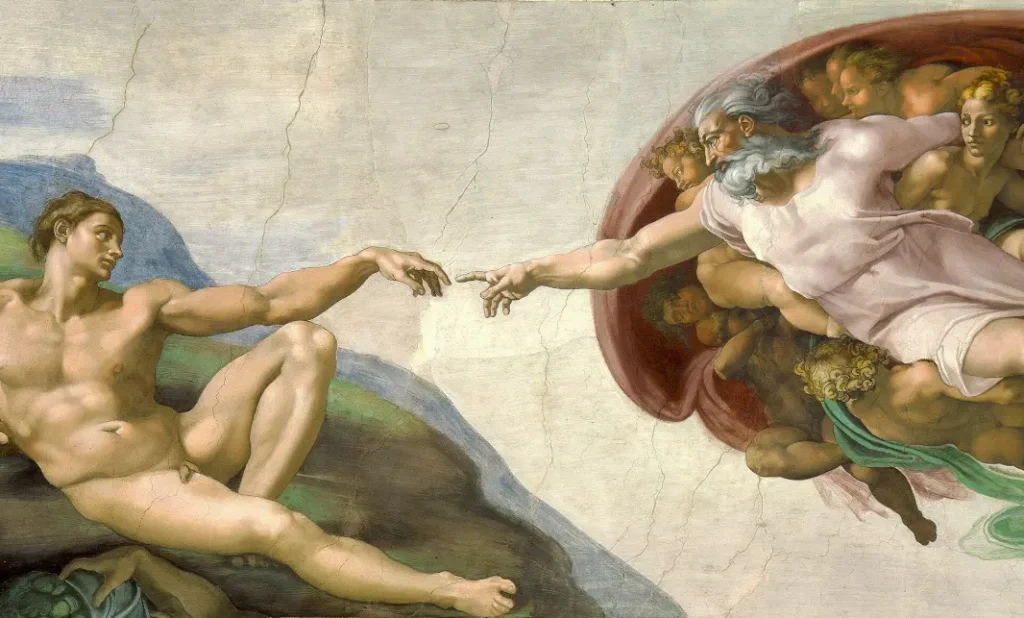
Humans possess a natural sense that there is something higher than themselves. Throughout history, some thinkers even argued that merely understanding the word “God” proves His existence. If God means the greatest possible being, and existing in reality is greater than existing only in the mind, then God must exist. Others claimed that since truth cannot be denied, and God is truth itself, God’s existence must also be undeniable.
These arguments sound convincing. Yet experience tells us that God’s existence is not obvious to everyone. A math equation may be clear to a trained mathematician and completely confusing to someone without that background. In the same way, even if God’s existence is implied by His nature, we do not directly know God’s nature. Because of that limitation, God’s existence is not self-evident to us.
People long for happiness or fulfillment, but that does not mean they automatically recognize God as the source of that desire. Simply thinking about something does not make it real. We can imagine a perfect island or a superhero, but imagination alone does not bring them into existence. If God exists, He must be more than an idea in the mind.
Some argue that belief in God belongs only to faith, not reason. St. Thomas Aquinas disagreed. While many truths about God are known through faith, some truths can also be known through reason. Even though God is far beyond our full understanding, we can know that God exists by looking at His effects in the world, moving from what we can see to what we cannot see, from visible realities to an invisible cause.
The Five Ways of St. Thomas Aquinas
Aquinas offers five ways of reasoning to God that begin with ordinary experience and work backward to a necessary source.
The argument from motion begins with change. Things move and change, but nothing moves itself into existence. Every change depends on something already actual. If we follow this chain back far enough, there must be a first source of motion that itself is not moved. This Unmoved Mover is what we call God.
The argument from cause and effect observes that everything in the world has a cause, and nothing causes itself. Causes form an ordered chain that cannot extend infinitely in the present moment. There must be a first, uncaused Cause that sustains all others. This First Cause is God.
The argument from possibility and necessity notes that many things come into being and pass away. They are contingent, they might or might not exist. If everything were contingent, then at some point nothing would have existed. If nothing ever existed, nothing would exist now. Therefore, there must be at least one necessary being that does not depend on anything else for existence. This necessary being is God.
The argument from degrees of perfection points to the fact that we judge things as better or worse, truer or less true, more or less beautiful. These comparisons only make sense if there is a highest standard by which all lesser degrees are measured. That ultimate standard of goodness, truth, beauty, and being itself is God.
The argument from design observes that non-intelligent things in nature act toward consistent goals. Trees grow in predictable ways. Planets follow stable paths. Natural processes operate with order and direction. Just as an arrow reaches its target because an archer directs it, nature appears ordered toward ends beyond itself. That directing intelligence is what we call God.
Quickly Answering Common Objections
Some object that an all-good and all-powerful God would not allow evil. Aquinas responds that God permits evil only to bring about a greater good. Evil does not exist on its own; it is a corruption of something good. For evil to exist at all, goodness must come first, and that ultimate Goodness is God.
Others argue that nature and human reason explain everything, making God unnecessary. Aquinas replies that nature itself requires a source and a goal, and human reason can fail or change. Anything that changes or can fail must depend on something that does not change or fail. That unchanging foundation is God.
Going Further
God’s existence may not be obvious at first glance, but it is knowable. By reflecting on motion, causality, contingency, degrees of perfection, and design, we are led beyond the visible world to an invisible but necessary cause.
God is the explanation for change, cause and effect, existence itself, objective standards of goodness and truth, and the order we observe in nature. These arguments do not give us everything about who God is, but they do show us that God is.
—
This article was made possible by The Fred & Rheta Skelton Center for Cultural Renewal.
Image credit: Michelangelo, Public Domain
























Leave a Comment
Your email address will not be published. Required fields are marked with *