
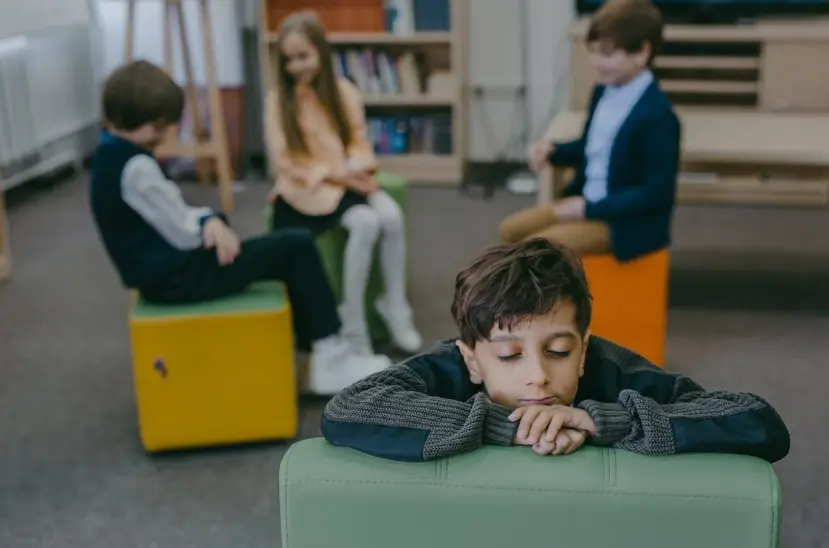
When most people hear that my siblings and I graduated high school years ahead of normal, scored high on state-standardized tests, and attended top colleges and universities, they generally assume our schooling was extremely strict, long, and arduous.
Our schooling was challenging, but it was never impossible. In fact, I realized only years later how shocking it was that I never recall spending more than two hours a day on schoolwork until high school. Even then, I hardly ever worked on homework during evenings or weekends. Thus, it boggles my mind how teachers find work for children as young as six or seven years old to do from 8:00 a.m. to 3:00 p.m.
It makes a lot more sense, however, when I encounter examples of the work these students are assigned. It seems obvious that very little, if any, of the time spent in a school is used for actually educating the students. Instead, public schools, and even many private schools, have become glorified daycares to help parents living in a dual-income economy.
Ohio gubernatorial candidate Vivek Ramaswamy was forced to edit a video last week over this issue. He controversially proposed “year-round school” and extended school days so that parents “don’t have to pay for childcare.” While some Republicans claimed the video was AI-generated, Ramaswamy’s own spokesperson later confirmed its authenticity.
Whether Ramaswamy is serious about this proposal remains to be seen, but it’s important to note that such a policy would not only raise the taxes citizens pay for local public schools, it would also worsen the education crisis American children currently face.
Why? Because when it comes to schooling, less is more.
As my aforementioned school experience demonstrates, most children without significant learning disabilities in grades K-8 can learn how to write, read, think, argue, perform mathematical equations, understand science, and explore history in less than two hours daily. The rest of their time can be spent in creative play, physical exercise, and exploration. In high school, learning hours may increase, but not to the point that a student should not be able to comfortably hold a part-time job, pursue an active hobby, and foster a social life.
“Advocates and public officials routinely argue that our kids need more time in school,” Forbes contributor Frederick Hess noted in 2023.
“As I’ve noted before, though, the reality is that American students actually spend about 100 hours more in school each year than their peers in other advanced economies. This doesn’t mean that American students necessarily get enough schooling. But it suggests that simply boosting the number of hours kids sit in school may be the wrong goal.”
Hess goes on to cite 2021 research estimating that “intercom announcements, staff visits, and students entering class in troublesome ways” accounted for 2,000 interruptions a year. Research from 2015 found that the school year went from about 1,076 hours to 670 hours when only counting actual instructional time. In other words, roughly 40% of time spent in school was spent doing things other than schoolwork.
Spread out over an 180-day school year, 670 hours is just over three-and-a-half hours a day. Suddenly, my estimation that schoolwork can take two hours or less for K-8 students doesn’t seem so far-fetched. And that’s not even counting the hours spent on woke indoctrination or critical race theory struggle sessions that hinder actual education. The fact is, it is very possible for a student to simultaneously have rigorous education and spend less time in educational institutions.
The current school day is arranged around the schedules of a typical family where both parents work. Yet even this situation leaves at least an hour at the end of the day where two full-time working parents must find childcare, as Ramaswamy pointed out. Thus, it seems that until we remedy the fact that parents are often forced to both work full time, a child’s school schedule will continue to mimic that of a 40-hour, 9-to-5 work week … and education in America will continue to suffer.
—
This article was made possible by The Fred & Rheta Skelton Center for Cultural Renewal.
Image Credit: Pexels
6 comments























6 Comments
Space Waves
December 3, 2025, 11:01 pmYou make a strong point: more hours in school don’t automatically mean better learning. A lot of the day really does get lost to non-instructional tasks, so longer schedules may just stretch the same inefficiencies.
REPLYKathy M Stegman@Space Waves
December 10, 2025, 11:22 amThat is why Homeschooling is the way togo!
REPLYJohn Curran
December 10, 2025, 6:41 amMy casual observation of my many homeschooled children is that the incentive to engage in free-time activities results in a more intense and concentrated effort to complete the assignments in much less time that in a classroom environment where the pace of learning is often slowed so as not to leave the slowest learner behind.
REPLYErin
December 10, 2025, 11:55 amThank you for putting these thoughts together!
REPLYI have been homeschooling for 10 years and my oldest kids have taken classes part time in the local middle and high school. Their greatest complaint is the waste of time (aside from the generally unpleasant atmosphere). They have been strategic about staying home to do math, instrument practice, etc on days when there is a sub and nothing happens, and they bring books for the “dead” time at the end of a math or science class. Mostly now they have opted to only take project based classes so that they can be self directed. (Or they’ve taken up computer games on the school provided laptops on the occasions they didn’t have something productive to do! Argh).
I’ve appreciated that being homeschooled gives them a sense of how to use their time, but I feel angry on behalf of the other full-time students who have no choice but to have so much of their lives wasted in mind-numbing boredom (and that’s not getting into the actual problems with teaching methods for the instructional time…).
Pierre V Comtois
December 10, 2025, 2:49 pmWhat I've been saying for years: extension of shcool hours is merely to accomodate working parents with free baby sitting services.
REPLYMari
December 10, 2025, 9:56 pmYou were not an ordinary but gifted and advanced student. It doesn’t sound like you are a teacher either who is yanked year after year to implement “new” ways to teach which cause so much turmoil for teachers. The overeducated and inexperienced administrators have no pulse for what really is effective in teaching. The effective teachers of ordinary kids use what works best and should be trusted to do so. One major flaw is lack of recess. We had 3 recesses throughout the day for all classes, grades 1-8. Discipline problems are enormous and require too much time away from instruction. Teachers cannot teach, but are required to be the parent. Teachers are leaving the profession in droves and i really feel for them. Most are genuinely caring and can’t do the job they want to do: TO TEACH.
REPLY