
This Thanksgiving, 36 members of my family – my children and grandchildren, a nephew and his wife, and an in-law still raw from the recent death of her husband – gathered in the kitchen and dining room of my daughter’s house. Following the mealtime blessing, we took turns expressing what we were thankful for, from the nephew who appreciated being included in the festivities to the 10-year-old who was grateful for the hat I’d given him earlier.
As this torch of gratitude passed from one person to the next, something happened to me. The room, the newly hewn and polished wooden top on the kitchen’s island table made by daughter’s husband, and all the faces in that rough circle took on a special light, which I can only think of as a holy glow. It was the radiance you see in some Renaissance religious paintings, chiaroscuro, that contrast of light and darkness that sharpens the faces on a canvas. This bright luminosity lasted less than a minute, but the beauty of that moment will stay with me for the rest of my life.
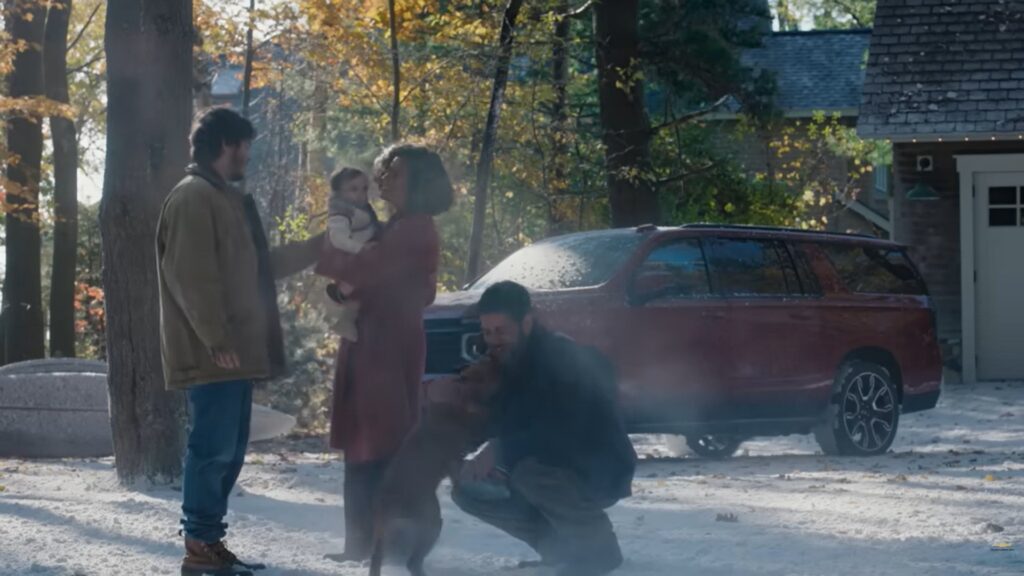
Three days later, I read Steve Watson’s online article about the new Christmas ad for Chevrolet, “Memory Lane.” This promotion depicts an older couple driving to meet their children and grandchildren for the holiday, a trip which brings back memories of Christmases past.
Chevy does touch the heart with this commercial – it’s already garnered more than 20 million views – but it was Watson’s concluding words which most moved me: “Chevrolet just reminded everyone how powerful it is to simply make something beautiful again.”
To extol an advertisement, which is really just a piece of propaganda promoting a product, for its beauty may seem silly and trite, yet Watson is spot on in his praise. Chevrolet’s depiction of a traditional family and the mother’s reminiscences are in fact things of beauty.
After all, beauty often appears under the guise of the small and the ordinary. The special lamp of love shining in the eyes of a mom with her newborn. The music found in two friends laughing together over coffee. The teen who writes poetry he’s too shy to give to the girl who has stolen his heart. The elderly man whose face is etched with the triumphs and travails of 80 years of living.
These are cliches, yes, but they’re also human truths dating back to the dawn of time. Whether it’s an ocean sunset or a painting, a face or a passage in a book, beauty is all around us.
In Mark Helprin’s “A Soldier of the Great War,” the novel’s aging hero and a professor of aesthetics, Alessandro, is speaking with a young Italian mechanic, Nicolo, about the nature of God. Alessandro says, “His existence is not a question of argument but of apprehension. Either you apprehend God, or you do not.”
The same holds true for beauty. It needs only apprehension – a pair of eyes, an active mind, and a dash of imagination – to live and breathe.
Whether church-goers or not, many Americans spend December sprinting toward Christmas Day, buying special gifts, decorating their homes, making plans for travel or get-togethers. Yet these stressful weeks of commotion and rush are also intended as the season of waiting and anticipation, and offer a golden opportunity to pause and practice the apprehension of beauty, which is hidden only by our blindness.
When we hear those time-worn songs and carols that play incessantly for a month on the radio, rather than complain we might try to hear anew the words and melodies that have for so long moved hearts and minds. When with open eyes and alert minds we watch beloved holiday movies – “It’s a Wonderful Life,” “White Christmas,” and even comedies like “Home Alone” or “A Christmas Story” – we may find beauty in those celluloid characters and plots. Best of all, when we’re shopping, at work, or at church, we can investigate faces known and unknown to us to see what manifestations of beauty, if any, may be glimpsed there.
And then? On Christmas Day, amid all the presents, feasts, and other activities, we can bring our newly polished skills to that scene so familiar to us that we often fail to comprehend its cosmic significance and eternal beauty: a babe in a manger in Bethlehem, his mother and father bent over him with love and prayers.
With a little practice this Advent season, we can, as Watson said, “make something beautiful again.”
—
This article was made possible by The Fred & Rheta Skelton Center for Cultural Renewal.
Image credit: YouTube/Chevrolet
























Leave a Comment
Your email address will not be published. Required fields are marked with *